
What Do Water Stains on a Ceiling Mean for Your Property?
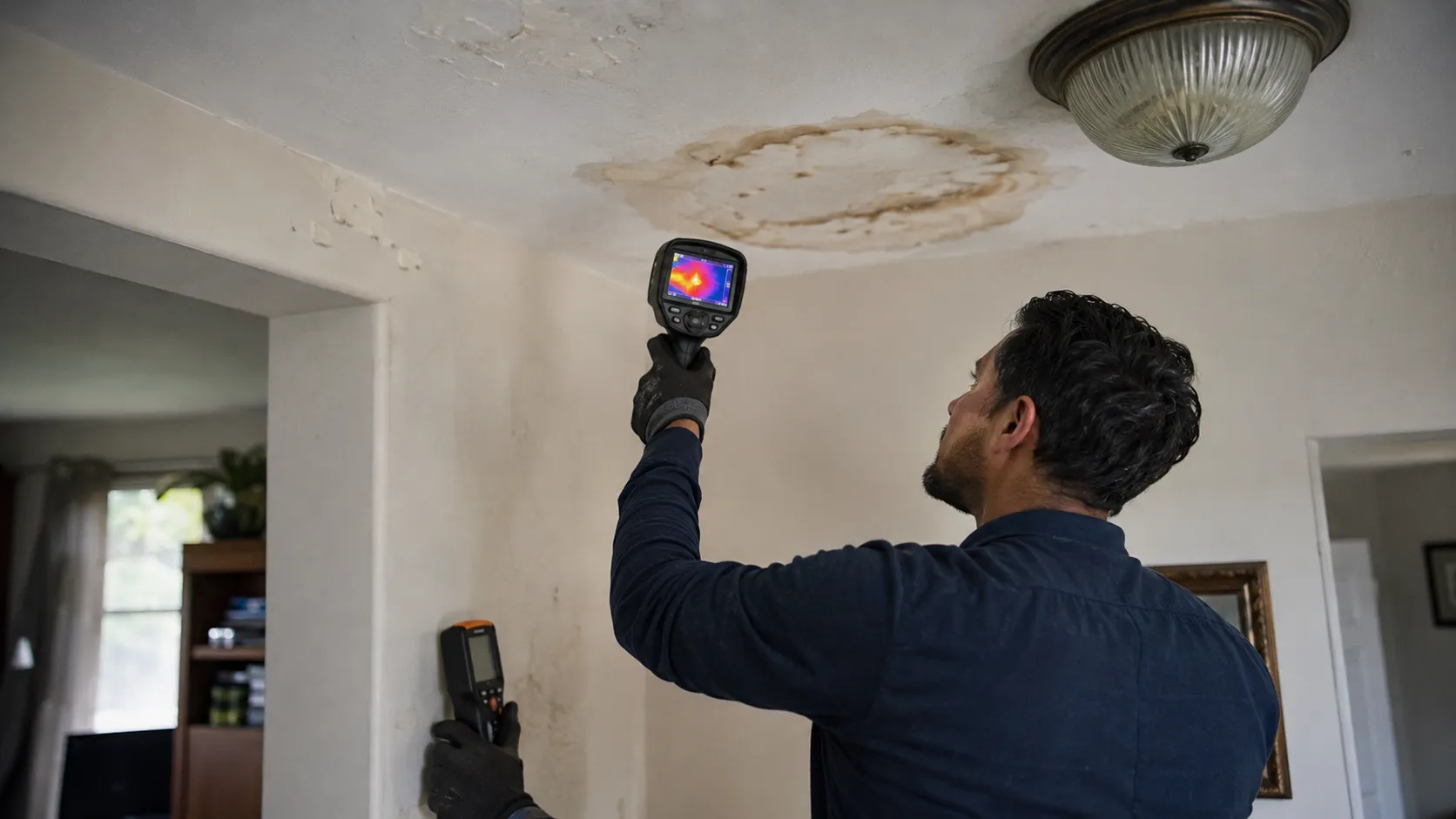

A water stain on a ceiling is a report from inside the building envelope. Water got in, traveled, and surfaced somewhere it had no business being. Most stains trace back to a compromised roof assembly, flashing that failed around a penetration, or an HVAC condensation line that’s been dripping quietly for weeks. The part people skip is the part that decides everything. Where did the water actually enter? Not where it showed up.
Does a Water Stain on the Ceiling Always Mean an Active Leak?
Not always active. Almost always a leak of some kind, though, past or present. A stain on a ceiling means water intrusion from above, usually a roof leak, failed penetration flashing, or condensation off HVAC equipment. It’s rarely a plumbing supply line dripping straight down.
Brown, yellow, ring-shaped. Those marks form because water dries and re-wets the same drywall paper fibers over and over. The ring is the tell. It means the source has run more than once, even if the ceiling feels bone dry to the touch today. Condensation does the same thing. A duct sweating in a hot attic, or a drain pan going over on a slow drip, leaves that same mark with no storm anywhere in the picture.
Painting over it buys you a season. That’s all it buys. Finish work comes last, after the source is found and closed off and the framing behind it has actually dried.
Primary Building Envelope Sources Behind Ceiling Stains
Four buckets cover almost every ceiling stain. Roof leaks and other exterior envelope defects above top-floor rooms. Plumbing leaks from lines or fixtures above the ceiling. HVAC condensation off ducts, drip pans, or drain lines. And indoor condensation from poor ventilation. Each one sends you toward a different repair, and guessing wrong costs you a repaint.
Here’s the thing that trips people up: the stain almost never sits under the entry point. Water runs along a truss, follows a wire chase, or pools on top of insulation before it soaks through drywall and shows up several feet away. That’s the whole reason a real building envelope inspection looks at the roof surface, the flashing details, the attic or roof deck, and the nearby HVAC components together, instead of treating the visible mark as the problem.
Los Angeles has its own wrinkle. Older homes in Culver City and West Los Angeles are still carrying original 1920s to 1950s stucco, with crawl spaces instead of basements, so water takes paths it never would in newer construction. Then you’ve got flat and low-slope commercial roofs across the basin baking in direct sun most of the year. When a heavy rain event finally shows up, it finds whatever the sun already weakened. Tracing a leak fast, before the next storm, matters more here than it would in a climate that rains steadily all year.
Roof Membrane Degradation and Low-Slope Failures
On a low-slope roof, membrane aging, punctures, open seams, and ponding water all create leak paths, and none of them run in straight lines. Water can sit on a weak spot for days before it finally works through. By the time it reaches the ceiling below, the membrane damage may already be spread well past that one point.
Location tells you plenty. A stain on a top floor or near an exterior wall that appears after rain points toward the roof membrane. A stain below a bathroom, kitchen, or mechanical closet points toward plumbing or HVAC instead. Different trade, different first phone call.
The roof repair happens before the ceiling gets patched, and the area needs real time to dry. For commercial and multifamily buildings, a stain that keeps returning after repeated rain events is a reason to have the whole roof assessed, not just the one spot that keeps bleeding through.
Failed Flashing Around Skylights and Roof Penetrations
Penetration flashing is what pushes runoff around skylights, vents, pipes, and roof edges so water never reaches the structural deck underneath. When a ceiling stain sits below or near one of those features, flashing failure is suspect number one. And the penetration itself is often still perfectly intact. It’s the sealant or the membrane transition around it that aged out or pulled loose.
Tracing the leak means looking uphill from the stain and checking the whole roof-to-penetration interface. Sealing whatever spot you can see from inside the attic isn’t tracing anything. A recurring stain near a skylight after rain gets repaired before anybody opens a paint can, because unresolved flashing will saturate that same section of ceiling every single time it rains.
When Does a Stained Ceiling Signal Hidden Structural and Mold Hazards?
An expanding stain, active dripping, or drywall that’s gone soft and started to bow. That’s past cosmetic. Source control first, then a professional assessment. Not a bucket and a tarp. If water is coming through during rain, see when a roof leak is an emergency.
Persistent moisture raises mold risk, though a stain by itself doesn’t prove mold is growing. The California Department of Insurance notes that water leaks can allow mold to develop, and that’s the practical reason materials behind a stain need prompt structural drying instead of a wait-and-see approach. Left wet, gypsum board and framing hold moisture at the core long after the surface looks and feels dry. A moisture meter tells you that. A glance doesn’t.
Photograph the stain. Note the date it appeared and anything that’s changed since. Then read your policy language carefully. Guidance from the Insurance Council of Texas notes that many policies exclude gradual leaks or seepage and the resulting mold damage. That’s Texas guidance on Texas policies, so don’t read it as a ruling on how a California policy handles the same claim.
Diagnostic Protocols for Locating Ceiling Moisture Sources in Los Angeles
Sequence beats tools. Document the stain and the conditions around it, recent rain, HVAC use, plumbing activity upstairs, then get into the space directly above it before touching anything below. From there: roof surface, flashing details, attic or roof deck, plumbing lines, then HVAC ducts, drain pans, and condensate lines. In that order. The source gets stopped before any drying or cosmetic repair starts, because drying a ceiling that’s still being fed by an open leak accomplishes nothing at all.
Professional leak tracing pairs the visual inspection with moisture mapping and thermal imaging. Thermal imaging picks up temperature differences that often correspond to wet material behind a finished surface. Moisture mapping uses electronic meters to mark the exact boundary of the damp area, which is almost never the boundary of the visible stain. You want both, because water travels away from its entry point, and because condensation can throw a heat signature that looks a lot like an active roof leak while being nothing of the kind. Skipping this step is the most common mistake in DIY ceiling stain repair. Patch drywall over a spot that tests dry on the surface and wet at the core, and you’ve just scheduled the next stain. The two tools answer different questions, and how water intrusion testing methods compare covers when each one is the right call.
Permitting comes down entirely to scope. Patching and repainting, along with most source-finding work, is typically cosmetic and doesn’t require a permit. Roof assembly modifications, structural repairs, and electrical work near the affected area commonly do. For properties in unincorporated Los Angeles County, permitted-work inspections are scheduled through the county’s EPIC-LA system. The city of Los Angeles and nearby cities including Santa Monica, Beverly Hills, and Culver City each set their own rules, so check with the building department that actually has jurisdiction before work starts on anything beyond a cosmetic patch.
One more thing, for hillside properties in Bel Air, Brentwood, and Pacific Palisades. Sometimes a ceiling stain has nothing to do with the roof. Slope drainage and retaining wall seepage can push moisture into a structure from below or from behind a wall, and that changes the diagnostic path and the repair both.
Related reading covers early signs of building envelope failure and how to tell exterior water intrusion from interior sources before repairs begin, plus a closer look at ceiling leak repair for roof and flashing sources.
Frequently Asked Questions
Can you safely paint over a water stain on the ceiling?
No, not without fixing the source first. Paint hides the discoloration. It does nothing to the water causing it, and the stain usually comes back after the next rain or the next time the HVAC system runs long enough to condense.
Do ceiling water stain repairs require a Los Angeles building permit?
Depends on the scope. Cosmetic patching and repainting generally doesn’t require a permit, while roof assembly changes, structural repairs, or electrical work near the damage commonly does. Confirm the specific requirement with the local building department, since city of Los Angeles, Santa Monica, Beverly Hills, and Culver City each administer this separately, and unincorporated county areas use the EPIC-LA system.
How quickly does mold develop behind a wet ceiling?
No fixed timeline is confirmed here, but the risk climbs the longer the material stays wet. The California Department of Insurance notes that water leaks can allow mold to develop, which is why structural drying should start as soon as the source is stopped, not after the ceiling gets repainted.
A ceiling stain that keeps coming back after patching almost always means the source was never actually found. Trace it properly, with moisture mapping and thermal imaging when the visible sign doesn’t match the likely path, and you stop repainting the same spot every rainy season. Get a Free Quote to have the source traced and stopped before further drywall saturation sets in.?
About the Author
 Cameron Figgins
Cameron Figgins is the founder of Absolute Maintenance & Consulting. With over 30 years of hands-on industry experience, he specializes in identifying complex water intrusion issues in Southern California homes and is dedicated to helping homeowners protect their property with the latest in detection technology.”