
Exterior vs. Interior Water Intrusion: How to Identify the Source Before Repairs Begin
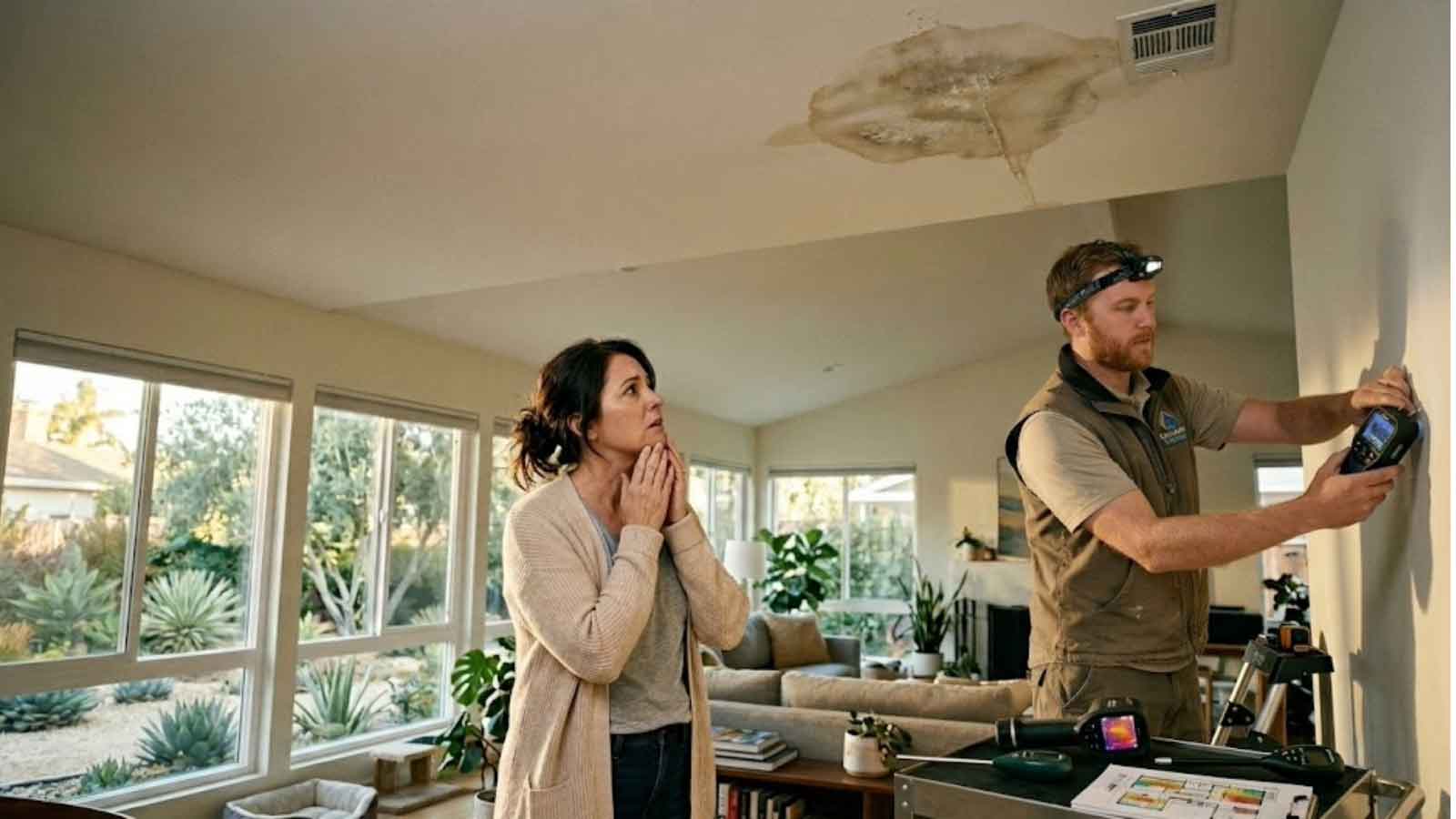

Finding water inside your home does not always tell you where the leak started. Water can travel along framing, pipes, ceilings, and walls before becoming visible, so the wet spot you see may be several feet away from the actual source. The first step is to look for patterns. Does the moisture appear only after rain? Does it show up when a sink, shower, or appliance is being used? Does the area dry during clear weather but return after the next storm?
These details can help narrow the problem down to exterior water intrusion or an interior leak. Identifying that difference before repairs begin is important because fixing the visible damage without addressing where the water entered can allow the same problem to return.
A Simple Diagnostic Framework
Most water damage cases come into focus when you check four things in this order:
- Location: Where is the damage, and what’s directly above or behind it?
- Timing: Does it appear after rain, or independent of weather?
- Pattern: Is it isolated to one spot, or spreading along a path?
- Confirmation: Do moisture readings, thermal imaging, or controlled water testing support the theory?
Treat the early observations as strong indicators, not certainties. Water behavior is rarely linear, and the most expensive misdiagnoses happen when a homeowner stops at the first plausible answer.
How to Tell If Your Water Leak Is Coming from Outside or Inside
The timing and location of the moisture are often the first clues to whether a leak is coming from the building exterior or an indoor source. The challenge is that the place where water appears is often not where it entered the home. Rainwater can travel through roofing materials, wall cavities, and framing before becoming visible, while plumbing leaks may spread behind walls or beneath flooring long before obvious damage develops.
The first step is determining whether the problem is related to weather or an interior plumbing system. That distinction helps narrow down the possible causes and ensures you contact the right professional. If the damage appears after storms, it may point to water intrusion in Los Angeles. If it develops regardless of the weather, an interior plumbing leak is often the more likely explanation.
Quick Diagnostic Cues: Where to Start
Use this as a starting point, then read the relevant section below for the full picture.
| What you notice | Likely category | Who to call |
| Damage shows up after heavy rain | Exterior intrusion | Building envelope specialist |
| Stain directly below an upstairs bathroom | Interior plumbing | Licensed plumber |
| Soft drywall near a dishwasher or washing machine | Interior appliance leak | Plumber or appliance technician |
| White chalky residue on the basement masonry | Past or ongoing exterior moisture | Building envelope specialist |
| Warm patch on a tile floor | Possible slab leak | Licensed plumber |
| Musty smell, no visible damage | Hidden moisture, humidity, or ventilation issue | Depends on the cause |
In most cases of water intrusion, one category fits cleanly. Some scenarios fall between the two, and a later section directly covers those false positives. The next sections cover each category in detail, beginning with exterior intrusion
How Exterior and Interior Damage Behave Differently
Damage that appears after rain and dries out during clear stretches is a strong indicator of an external source. The specific category depends on where the damage shows up and how it behaves.
Reading the Signs of Exterior Water Intrusion
Exterior water intrusion often follows a pattern tied to weather conditions. Stains may grow during heavy or wind-driven rain, moisture may appear around windows or exterior walls, and affected areas may begin drying once the weather clears. Tracking when and where these signs appear can help narrow down possible entry points such as roofing, flashing, stucco, windows, or exterior waterproofing.
Roof and Window Leaks
Roof and window leaks are the most frequent exterior sources in residential homes, and they don’t always look the way homeowners expect.
Water entering through a roof rarely drips straight down. It travels along rafters, sheathing, and ceiling joists before showing up as a stain, sometimes several feet from the actual entry point. Window leaks often appear as discoloration around frames, peeling paint along the sill, or staining on the wall directly below the window after wind-driven rain.
Common signs to watch for:
- Ceiling stains that grow or darken after a storm
- Discoloration around skylights, vents, or chimney flashing
- Peeling paint or warped wood near window frames
- Water marks on attic rafters or insulation
Stucco and Above-Grade Wall Intrusion
Cracks in stucco, gaps around penetrations, and failures along weep screeds let rainwater enter the wall cavity at points well above the foundation. The damage often shows up inside the home as discoloration on interior walls after wind-driven rain.
Visible markers worth flagging:
- Hairline cracks in stucco that widen over time
- Discoloration along the weep screed at the base of stucco walls
- Staining on interior walls that appears only after storms hit a specific direction
Foundation and Below-Grade Water Damage
Water at the base of basement walls, on a slab floor, or in a crawl space typically points below grade. When the surrounding soil becomes saturated, hydrostatic pressure pushes groundwater through cracks, joints, and porous masonry.
Timing is the clearest diagnostic signal. Dampness at the wall-to-floor joint appearing within a day or two of heavy rain, then drying out between storms, points to groundwater. The same low spots tend to repeat.
Visible markers:
- Efflorescence (the white chalky residue left when moisture moves through masonry and evaporates)
- Stair-step cracks in block foundations
- Hairline cracks in poured concrete that widen over time
- Exterior staining running downward from grade level
Cracks that widen between seasons and water that returns to the same spot after every storm signal progressive failure, not a cosmetic issue.
One important note: bowing or leaning foundation walls are a structural problem, not a waterproofing one. Cracks that run horizontally across a wall also fall into this category. If you see either, bring in a licensed structural engineer before any water repair work begins.
Read More: Can Water Damage Be Repaired? An Expert Guide for Los Angeles Property Owners
Recognizing Interior Plumbing and System Failures
Interior leaks tend to be associated with a specific fixture, pipe, or piece of equipment. Knowing which interior category you’re dealing with helps you call the right professional the first time.
Supply Line Leaks
Pressurized supply lines (the lines that bring water to your fixtures) leak under constant pressure, so even pinhole leaks can release a steady stream. Damage appears continuously rather than intermittently and often shows up as warm or hot patches if a hot water line is involved.
Common signs:
- Soft drywall behind a sink, toilet, or shower
- The water bill is climbing with no change in usage
- Drop in water pressure at a fixture
- Warm patches on slab floors, which can indicate a slab leak
Slab leaks are plumbing failures and require a licensed plumber to locate and repair.
Drain and Waste Line Leaks
Drain lines only release water when a fixture is in use, so the damage is intermittent. Stains may appear after a shower or after the dishwasher runs, then dry out.
Common signs:
- Ceiling stains directly below a tub, shower, or upstairs bathroom that worsen after use
- Sewage odors near walls or floors
- Cabinet floor damage that appears overnight after running a dishwasher
Appliance Failures
Dishwashers, washing machines, refrigerators with ice makers, and water heaters all rely on supply hoses, drain hoses, and valve connections that can fail. The damage is location-specific and almost always tied to the appliance footprint.
Common signs:
- Soft cabinet floor under a sink with a dishwasher behind it
- Stained or warped flooring directly in front of a washing machine
- Water pooling under or behind a refrigerator with an ice maker
- Rust or corrosion at the base of a water heater
HVAC Condensation Issues
Air conditioning systems produce condensate that drains through a dedicated line. When that line clogs, water backs up and saturates the drywall around the air handler.
Common signs:
- Damage in or around an HVAC closet
- Ceiling stains directly below an attic-mounted air handler
- Damage that appears during the cooling season but not during rain events
How Diagnostic Tools Confirm an Exterior Source
In many exterior cases, professional water leak detection combines moisture mapping, infrared thermal imaging, and controlled water testing to identify the true entry point before unnecessary demolition begins.
When the damage points exterior but the entry point isn’t obvious, a building envelope specialist uses three core methods before any drywall comes out. Each one answers a different question. Together, they build a documented trail from the visible damage back to the breach in the envelope.
Non-Invasive Moisture Mapping
A moisture meter measures the actual water content in building materials such as drywall, framing, sheathing, and insulation. Readings are taken across the affected area to build a moisture gradient. The gradient is what makes this useful because water flows from wet to dry, and the highest readings are closest to the source.
What the homeowner sees:
- A technician moving a small handheld device across walls, ceilings, and baseboards
- Twenty to fifty readings logged across the affected zone
- Pin-type meters that take readings through small contact pins, or pinless meters that scan through the surface
- No drilling, opening, or disturbance to finished surfaces
Infrared Thermal Imaging
Thermal cameras detect temperature differences as small as a tenth of a degree behind finished surfaces. Wet materials hold and release heat differently than dry ones, so saturated framing, soaked insulation, or wet drywall cavities show up as distinct shapes on the thermal image. The camera does not see water directly; it sees the temperature signature water leaves behind. That temperature signature is what thermal imaging leak detection follows to trace water back toward its entry point without opening the wall.
What thermal imaging adds to a moisture map:
- Visual confirmation of where water has traveled inside a wall assembly
- Diagonal moisture trails showing how water followed a stud or rafter from the entry point to the damage
- Coverage of areas a moisture meter cannot easily reach, like ceilings and high walls
- A reviewable image record of every finding
ASTM E1105 Water Testing
ASTM E1105 is a standardized test that applies controlled water spray to a specific exterior area while a second technician watches the interior for any sign of penetration. It isolates one suspected component at a time. Because the spray rate and pressure are standardized, results are repeatable and defensible, which matters for insurance claims and construction defect documentation.
When E1105 is the right tool:
- The previous two methods narrow the source to a few candidates, but cannot distinguish between them
- A specific window, stucco section, flashing detail, or deck-to-wall transition needs to be confirmed or ruled out
- The findings will be used in an insurance or warranty claim
- Each test runs thirty minutes to an hour per area, with timestamped photos and readings recorded as documentation
Precise findings translate into a smaller repair scope. Instead of opening three walls to find a single entry point, the work targets one section.
False Positives: Symptoms That Mislead Even Experienced Homeowners
Some symptoms point one direction and turn out to be the other. The cases below often enough mislead people to merit their own discussion.
- A slow roof leak can soak attic insulation for weeks, then show up as a ceiling stain on the floor below long after the rain has stopped. The cause is external, but the symptom appears to be a delayed plumbing leak.
- A clogged HVAC condensate line can produce ceiling damage that resembles a roof leak. The fix is HVAC, not envelope.
- Foundation seepage and a slow plumbing leak near a slab edge can present identically: damp baseboard, soft drywall a few inches up the wall, and no clear source. Only weather correlation separates the two, and the answer determines which trade you call.
- A musty smell isolated to one room may not be a leak at all. Poor ventilation, high indoor humidity, or condensation on cold surfaces can produce the same odor.
- A window leak can mimic damage caused by interior humidity. Condensation forming on cold glass and dripping onto sills produces staining that appears to be rainwater entry but originates from indoor air.
This is where forensic leak detection earns its place for exterior cases. A homeowner calls about a “roof leak,” and forensic investigation traces the source to a window flashing failure or a stucco crack on the opposite side of the building. The damage point and the entry point can sit fifteen feet apart along a single rafter or stud.
Read More: Why Is Rain Leak Detection In Los Angeles So Important?
Choosing the Right Repair Path Once the Source Is Confirmed
A confirmed exterior source necessitates repairs targeting the failed component. A confirmed interior source calls for the appropriate trade. Matching the path to the source is what prevents a second round of damage later.
Exterior Repairs (Building Envelope Work)
The right approach depends on where the water is coming in:
- Roof leaks require flashing repair, sealant work, or partial reroofing
- Window leaks require resealing, flashing replacement, or full window replacement
- Stucco intrusion calls for crack repair and waterproof coating
- Foundation and below-grade intrusion typically requires excavation, exterior waterproofing membranes, or drainage system installation
The cost of wall leak repairs, which combine diagnostics, exterior repair, and interior restoration, depends on the scope and whether mold remediation is needed. For the diagnostic side on its own, see how much a water intrusion specialist costs.
Interior Repairs
When the source is internal, the right professional handles it directly. A plumber locates and repairs the failed pipe, supply line, or fixture connection. An appliance technician addresses failures in appliance hoses. An HVAC contractor clears or replaces a clogged condensate line. After the source is fixed, water damage restoration can begin by drying affected materials, repairing damaged drywall and flooring, and addressing any mold that developed during the leak.
How Long Can You Wait Before Water Damage Gets Worse
The right response time depends on the consequences of waiting.
Act within 24 hours when delay risks structural damage, electrical failure, or mold:
- Active dripping or standing water (mold can begin growing within 24 to 48 hours)
- Ceiling sagging or visible bulging (collapse risk)
- Electrical fixtures near moisture (shock and fire risk)
- Sewage backup (biohazard exposure)
Schedule within the week when damage is contained, but compounding:
- Sustained hidden moisture inside walls (mold develops behind the surface)
- Unresolved active leaks (water waste and continued saturation)
- Stains expanding between rain events (worsening envelope failure)
Monitor and address soon when the issue is stable and cosmetic, including minor efflorescence, hairline cracks that aren’t widening, and isolated staining that hasn’t changed in months.
Waiting too long to investigate water damage can significantly increase repair costs. While some issues can be monitored briefly, others require immediate attention because moisture continues spreading behind finished surfaces even when the visible stain appears small.
Read More: Interior vs. Exterior Waterproofing: Pros, Cons, and Costs
Actions That Complicate Diagnosis and Increase Repair Costs
A few common reactions make the underlying problem worse or harder to diagnose:
- Don’t repaint over a stain before the source is confirmed. Fresh paint hides the recurrence pattern, which is often the most useful diagnostic clue
- Don’t seal an interior wall for a problem coming from outside. Coatings hide the symptom while the structure keeps absorbing moisture
- Don’t ignore small recurring stains. A stain that returns in the same spot after every rain is signaling an unresolved entry point, not a one-time event
- Don’t run an HVAC system through visible water damage near the air handler. Mold spores can spread through the duct system before the leak gets repaired
- Don’t tear out drywall until moisture mapping is complete. Targeted demolition based on moisture readings keeps the repair scope smaller
Frequently Asked Questions About Exterior vs. Interior Water Damage
How long after rain should water damage appear?
It depends on the entry point. A direct roof or window failure can show interior damage within hours. A slow leak through a stucco crack or attic insulation can take days or weeks to surface, which is why some ceiling stains appear long after a storm has passed. Damage that consistently appears within 24 to 72 hours of rain is the clearest signal of an active envelope failure.
When should I call a building envelope specialist instead of a plumber?
Call a building envelope specialist when the damage correlates with rain, sits near an exterior wall or window, or appears below a roof with no plumbing above it. Call a plumber when the damage appears, regardless of the weather, in a bathroom or kitchen, or near an appliance. If both descriptions fit, start with the envelope specialist. Their diagnostic tools can quickly rule out an external source and redirect you if the cause turns out to be internal.
Why does my ceiling stain return every time it rains?
A recurring rain-correlated stain almost always means the original entry point was never found. A previous repair likely patched the visible damage without tracing the water back to where it actually enters the envelope. Common true sources include window flashing failures, stucco cracks above the stain, roof penetrations, and roof-to-wall transition flashings. Forensic leak detection finds the real entry point, so the next repair holds.
What Should I Document Before Calling an Expert?
Whether you call a building envelope specialist, a plumber, or another trade, the conversation goes faster, and the diagnostic visit is more productive if you arrive with a few specifics in hand:
- Photos of the damage from multiple angles, including close-ups and one wider shot showing the room context
- The date you first noticed the damage and how it has changed since
- Whether the damage worsens after rain, after a specific appliance runs, or independently of either
- The age of your home and the type of exterior cladding (stucco, siding, brick, mixed)
- Any recent renovations, roof work, or plumbing repairs in the past two years
- A note on whether the same area has had previous repairs that didn’t hold
This information helps the specialist narrow down likely sources before they arrive, which usually shortens the on-site assessment.
Get a Building Envelope Inspection If Your Damage Points to the Exterior
If your damage shows up after rain, lives near a window or stucco wall, or has stumped previous contractors, the source is almost always in the building envelope.
Absolute Maintenance & Consulting is an exterior water intrusion investigation and building envelope repair specialist serving Los Angeles County for over three decades. Founded by Cameron Figgins, our team holds CSLB license #998184, IICRC certification, and MICRO certification.
We are not plumbers. If your leak is from a pipe, supply line, drain, slab leak, dishwasher, washing machine, or HVAC condensate line, call a licensed plumber, appliance technician, or HVAC contractor. If you are not sure which category your problem falls into, call us and describe what you are seeing. We will tell you honestly if it is our kind of problem or if you need a different specialist.
Visit our contact page or call us today to schedule a building envelope inspection.
About the Author
 Cameron Figgins
Cameron Figgins is the founder of Absolute Maintenance & Consulting. With over 30 years of hands-on industry experience, he specializes in identifying complex water intrusion issues in Southern California homes and is dedicated to helping homeowners protect their property with the latest in detection technology.”