Fire Damage Restoration in Los Angeles
Your building survived the fire, but the damage is not over. Absolute Maintenance & Consulting provides fire damage restoration for residential and commercial properties in Los Angeles with a specific focus on what happens after the flames are out: the water damage from firefighting efforts, the smoke and soot damage that penetrates building materials, and the mold growth that starts within 48 hours of water saturation.
Most fire damage restoration companies focus on the charred structure. We focus on the building envelope. Firefighting hoses can deliver 150 to 250 gallons per minute into a structure. That water saturates walls, ceilings, floors, insulation, and framing. It pools in crawl spaces and soaks into foundations. If that water is not extracted and the structure is not properly dried, mold takes hold within days, and the water damage often exceeds the fire damage itself.
Cameron Figgins, founder of Absolute Maintenance & Consulting, has spent over three decades restoring fire-damaged properties in Los Angeles County. We hold IICRC certification (#70018676) for water damage restoration, MICRO certification for mold assessment, and CSLB license #998184.
Fire Damage
Why Firefighting Water Causes More Damage Than You Expect
Fire departments use enormous volumes of water to suppress fires. A single engine company can pump 1,000+ gallons per minute onto a structure. That water does not evaporate. It absorbs into every building material it contacts: drywall, wood framing, insulation, concrete, plaster, and flooring. It travels through wall cavities, pools on subfloors, and seeps into crawl spaces and foundation areas.
The water damage from firefighting creates three urgent problems:
Structural saturation. Wood framing and subfloor materials that absorb firefighting water lose structural integrity as they swell and soften. Prolonged saturation weakens load-bearing members and creates conditions for rot. The building envelope must be assessed to determine which structural components can be dried and saved and which need replacement.
Mold growth. Mold begins colonizing damp building materials within 24 to 48 hours of water exposure. After a fire, the combination of moisture, warm temperatures, and organic building materials creates ideal conditions for rapid mold development. Every room that received firefighting water is at risk. A mold inspection within the first week is critical.
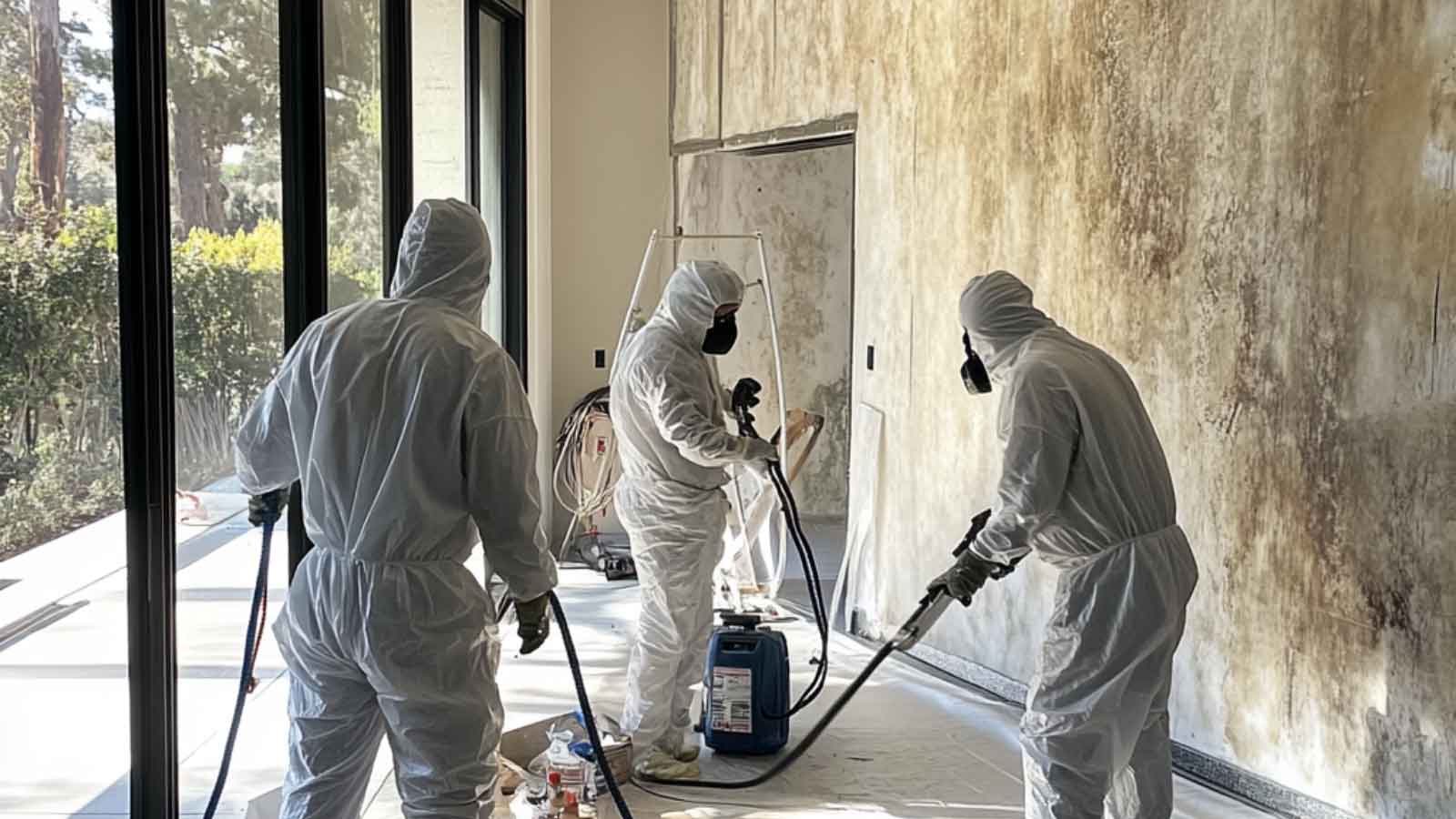
Secondary water intrusion. Fire damages the building envelope itself. Heat warps flashing, melts sealants, cracks stucco, and destroys roofing materials. After the fire, the compromised envelope allows rainwater to enter the structure through openings that did not exist before the fire. This creates ongoing water intrusion that continues long after the firefighting water is gone.
Contact Our Fire Cleanup Experts Today
Residential Fire Damage Restoration
If your home in Los Angeles has been through a fire, here is what Absolute Maintenance & Consulting addresses:
Water extraction and structural drying. We extract standing water, set up commercial-grade dehumidifiers and air movers, and monitor moisture levels with moisture mapping until all building materials return to acceptable levels. Drying a fire-damaged home typically takes 3 to 7 days depending on the volume of firefighting water and the extent of saturation.
Smoke and soot removal. Smoke penetrates every surface: walls, ceilings, textiles, HVAC ductwork, and personal belongings. Soot contains acids that corrode metals and discolor surfaces permanently if not cleaned within days. We use HEPA-filtered air scrubbers, thermal fogging for odor neutralization, and surface cleaning specific to the type of soot (dry, wet, protein, or fuel-based).
Building envelope assessment and repair. Fire compromises the building envelope. We perform a full building envelope inspection to identify where the roof, walls, windows, or flashing have been damaged by heat. We then repair the building envelope to prevent ongoing water intrusion from rain.
Mold prevention and remediation. If we can begin drying within the first 24 to 48 hours, we often prevent mold from establishing. If mold has already started, we perform mold remediation following IICRC S520 standards with full containment and HEPA air filtration.
Commercial Fire Damage Restoration
Commercial fires in Los Angeles require rapid response to minimize business interruption and protect the building for tenants and occupants. Absolute Maintenance & Consulting provides commercial fire damage restoration for:
- Office buildings and retail spaces where firefighting water migrates across floor plates, down elevator shafts, and through mechanical chases. We map the full moisture extent with thermal imaging and deploy targeted drying to minimize the affected area.
- Multi-unit residential where fire and firefighting water in one unit affects adjacent and below-grade units. We assess damage in every affected unit and document the scope for HOA boards, property managers, and insurance.
- Restaurants and food service where fire suppression systems discharge chemical agents in addition to water. We handle both the water extraction and the chemical cleanup.
- Warehouses and industrial spaces with large floor areas that require high-volume water extraction and commercial-scale drying equipment.
Commercial fire damage reports from Absolute Maintenance & Consulting include moisture mapping documentation, building envelope assessment findings, smoke damage evaluation, and recommended restoration scope formatted for insurance claims and property management.
Ready to experience the Absolute Maintenance difference?
Our Fire Damage Restoration Process
|
Phase |
What We Do |
Timeline |
|
1. Emergency Response |
Assess fire damage extent, identify immediate hazards, secure the building if needed |
Within 24 hours of clearance from fire department |
|
2. Water Extraction |
Remove standing firefighting water from all accessible areas using truck-mounted and portable extraction equipment |
Day 1-2 |
|
3. Building Envelope Assessment |
Thermal imaging and visual inspection of roof, walls, windows, and foundation to identify fire damage to the building envelope |
Day 1-2 (concurrent with extraction) |
|
4. Structural Drying |
Deploy commercial dehumidifiers and air movers. Monitor moisture levels daily with moisture meters. |
Days 2-7 (varies by saturation level) |
|
5. Smoke and Soot Cleaning |
HEPA air scrubbing, surface cleaning, thermal fogging for odor, HVAC duct cleaning |
Days 2-5 (concurrent with drying) |
|
6. Mold Assessment |
Inspect for mold development in all moisture-affected areas. Perform remediation if growth is found. |
Day 5-7 |
|
7. Building Envelope Repair |
Repair fire-damaged roof, wall, window, and flashing components to restore weathertight envelope |
After drying complete |
|
8. Reconstruction |
Replace destroyed drywall, framing, insulation, flooring, and finishes |
After envelope repair and mold clearance |
Total restoration timeline depends on fire severity and building size. Small residential fires with limited firefighting water: 2 to 4 weeks. Major residential or commercial fires: 4 to 12 weeks. We provide timeline estimates specific to your property after our initial assessment.
Smoke Damage Restoration
Smoke damage affects areas far beyond the fire itself. Smoke travels through HVAC ductwork, wall cavities, and any opening in the building. Properties with no visible fire damage can have extensive smoke contamination throughout the structure.
We address four types of smoke damage:
- Dry smoke residue from fast-burning, high-temperature fires (wood, paper). Powdery, easier to clean but penetrates porous surfaces.
- Wet smoke residue from slow-burning, low-temperature fires (plastics, rubber). Sticky, smeared, and pungent. Requires specialized cleaning agents.
- Protein smoke residue from kitchen fires. Nearly invisible but produces intense odor that penetrates every surface. Often the most difficult to eliminate.
- Fuel smoke residue from petroleum-based fires. Dense, black, and corrosive. Requires aggressive cleaning and often material replacement.
Our smoke damage restoration includes HEPA air scrubbing to remove airborne particulates, surface cleaning appropriate to the smoke type, thermal fogging for deep odor neutralization, ozone treatment for persistent odors, and HVAC ductwork cleaning to prevent smoke from recirculating after restoration.
Contact Our Fire Damage Experts Today
Fire Damage Restoration Cost
Fire damage restoration costs vary significantly based on fire severity, building size, amount of firefighting water, and smoke penetration extent.
|
Service Component |
Typical Range |
|
Initial assessment and emergency response |
$500 – $1,000 |
|
Water extraction and structural drying |
$1,500 – $5,000+ (based on area and saturation) |
|
Smoke and soot cleaning |
$2,000 – $8,000+ (based on area and smoke type) |
|
Mold prevention / remediation |
$1,200 – $4,800 per affected area |
|
Building envelope repair |
Quoted per project after assessment |
|
Reconstruction |
Quoted per project after drying and mold clearance |
Most fire damage restoration is covered by homeowners or commercial property insurance. We work directly with insurance companies and provide the documentation adjusters need to process your claim. If you are navigating a claim, see our water damage insurance claims resource.
Call (310) 678-4345 for an assessment of your fire-damaged property.
Why Choose Absolute Maintenance & Consulting for Fire Damage Restoration?
We understand that firefighting water is the real threat. While other restoration companies focus on charred materials, we focus on the water. Firefighting water saturates structures and creates mold conditions within 48 hours. Our water intrusion expertise means we know how to extract, dry, and protect your building from ongoing moisture damage.
We repair the building envelope, not just the interior. Fire damages the building envelope: roof materials warp, flashings melt, sealants fail, stucco cracks from thermal stress. If these envelope breaches are not repaired, rainwater enters the structure long after the fire restoration is complete. We perform a full building envelope inspection and repair on every fire damage project.
Three decades of fire damage experience. Cameron Figgins has restored fire-damaged properties across Los Angeles County for over three decades. He holds IICRC, MICRO, and CSLB credentials specifically relevant to water damage restoration and mold assessment.
We prevent the mold that follows fire. Our immediate mold assessment and prevention protocol addresses the 48-hour mold window that most homeowners are not aware of. Early intervention saves thousands in remediation costs later.
Frequently Asked Questions
How quickly do I need to start fire damage restoration?
As soon as the fire department clears the property. Firefighting water begins causing secondary damage immediately. Mold can begin growing within 24 to 48 hours of water exposure. Smoke residue becomes harder to remove the longer it sits on surfaces. We recommend beginning the restoration process within 24 hours of fire department clearance.
Does insurance cover fire damage restoration?
Most homeowners and commercial property policies cover fire damage restoration, including water extraction, smoke cleaning, mold prevention, and reconstruction. We work directly with your insurance company and provide detailed documentation for your claim. See our water damage insurance claims page for more on the claims process.
How much does fire damage restoration cost in Los Angeles?
Costs range from $5,000 to $50,000+ depending on fire severity, building size, and extent of firefighting water and smoke damage. Small kitchen fires with limited water: $5,000 to $15,000. Significant structural fires: $20,000 to $50,000+. Most costs are covered by insurance. Call (310) 678-4345 for a free initial assessment.
Why does mold grow after a fire?
Firefighting water saturates building materials. Mold spores, which are present in every environment, begin colonizing those damp materials within 24 to 48 hours. The combination of moisture, warm temperatures from residual heat, and organic building materials (wood, drywall paper) creates ideal conditions. Rapid water extraction and structural drying prevent mold. Delayed response almost always leads to a mold remediation project on top of the fire restoration.
Can fire-damaged buildings be saved?
In most cases, yes. Unless the fire compromised primary structural members (load-bearing walls, foundation), the building can be restored. The key is addressing firefighting water damage quickly to prevent secondary damage from mold and rot. We assess structural integrity as part of our initial evaluation and tell you honestly which components can be dried and saved and which need replacement.
Yes. We offer flexible payment options and can often arrange direct insurance billing so you only pay your deductible. We’ll discuss financial options during your free consultation.
Cleaning removes visible soot and smoke residue. Restoration includes cleaning plus repairing or replacing damaged materials, eliminating odors, and returning your property to its pre-fire condition. Most fire damage situations require full restoration, not just cleaning.
Still have questions? Our experts are here to help.
Service Area
Absolute Maintenance & Consulting performs building envelope inspections throughout Los Angeles County, including West Los Angeles, Santa Monica, Venice, Culver City, Beverly Hills, Brentwood, Bel Air, Century City, Hollywood, Silver Lake, Echo Park, Pasadena, Glendale, Studio City, Sherman Oaks, Encino, and the South Bay communities.
Call (310) 678-4345 or email info@leakmoldrepair.com to schedule your building envelope inspection.