
How Does Mold in an Apartment Building Spread Between Units?
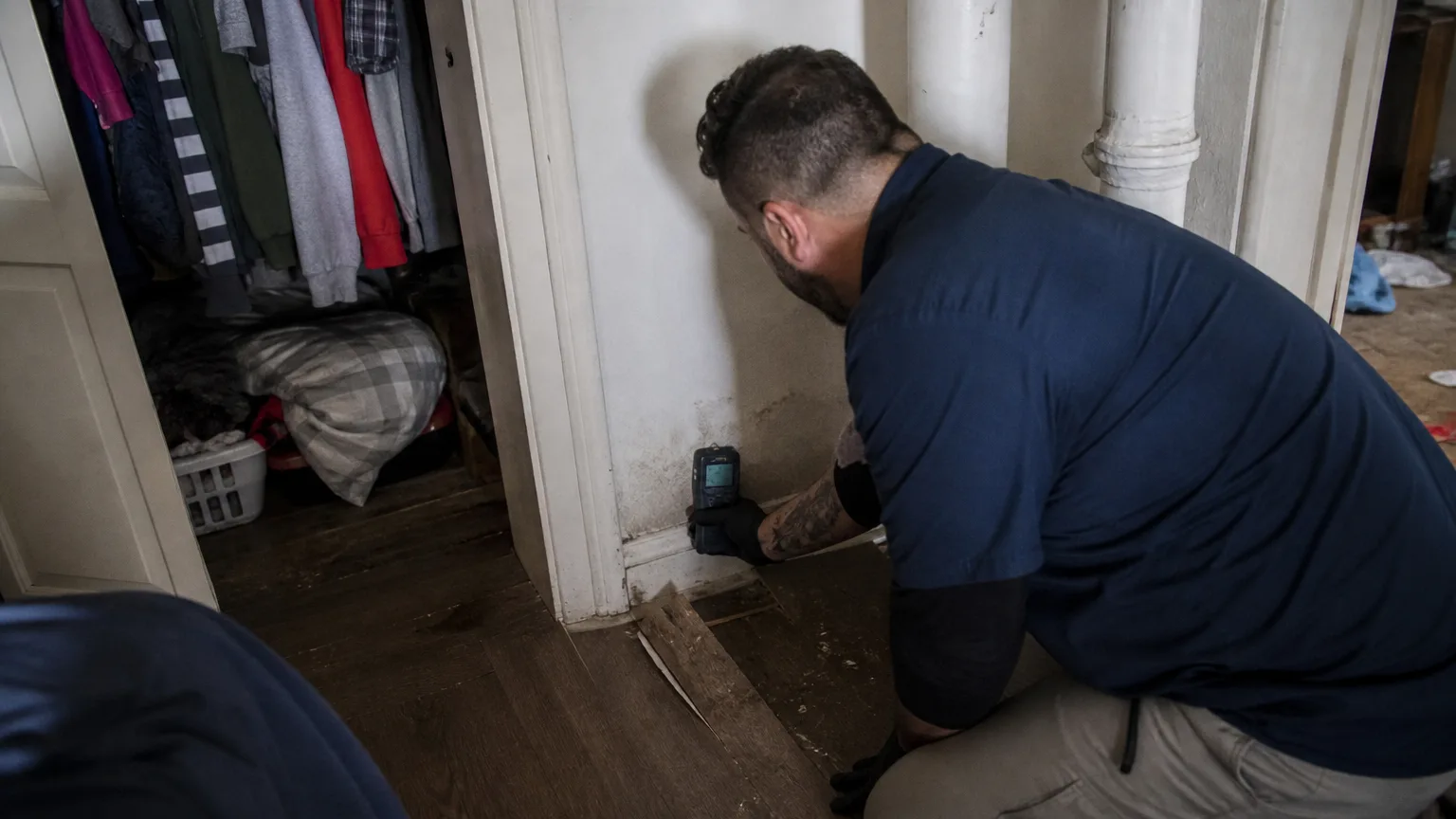

Mold in one apartment rarely stays in one apartment. If moisture’s been getting into a shared wall, a floor-ceiling assembly, or a plumbing chase, the unit next door, above, or below is already exposed. Doesn’t matter if anyone there has noticed a stain or a smell yet. Most tenants miss this. Honestly, some property managers miss it too: by the time mold shows up in one place, the moisture behind it has usually had weeks or months to travel already. Want to see how that moisture actually gets in? Our professional mold remediation in West Los Angeles page walks through the contain-and-fix process from start to finish.
Can Mold in an Apartment Building Travel Through Shared Walls?
Yes. In a multi-unit building, mold spreads through shared walls, floor-ceiling assemblies, and ventilation. That means one unit’s problem can quietly become several units’ problem.
Moisture drives it, not spores floating around. A leak inside a wall, condensation on a cold pipe, high relative humidity trapped by a failed exhaust fan, any of these will grow mold inside a wall cavity long before anything shows on the paint or drywall. Spores need wet material to take hold. Without it they just sit there doing nothing.
If a tenant reports visible mold or a musty smell, check the units next door, above, and below too, not just the room where it turned up. Moisture hiding inside the shared structure may have already crossed into a neighbor’s space while their walls still look clean.
Primary Cross-Unit Pathways for Moisture and Spore Migration
The routes are consistent from building to building: the party wall cavity between two units, the floor-ceiling assembly separating stacked units, plumbing chases running vertically through multiple floors, penetrations cut for wiring or ducts, shared corridors, and common HVAC return-air paths. Any of these can carry moisture, and once mold is established, air movement through the same openings can carry particles along with it.
Moisture and spores don’t move the same way. Treat them as one problem and you’ll end up making bad decisions. Moisture creates the conditions for growth inside a cavity. It just sits there, soaking into framing or insulation, whether the HVAC is running or not. Spores need air to move. That means a pressure difference or an open path: a gap around a pipe, a loose access panel, a return grille pulling air from more than one space.
For a property manager, the unit where mold was reported is where the inspection starts, not where it ends. Check both faces of the shared wall. Check the unit above, below, and beside it. Do that before anyone signs off on the problem being contained.
Floor-Ceiling Assemblies and Common Utility Chases
Moisture can travel through a floor-ceiling assembly and hit the unit above or below the source, even when everything in that neighboring unit looks bone dry. That assembly is made up of subflooring, joists, and the drywall ceiling underneath it, and moisture can sit inside there for a long time before it ever shows up on a surface you can actually see.
If you’re seeing staining, smelling that musty smell that won’t go away, finding damp finishes, or dealing with condensation that keeps coming back, that’s your sign to open the assembly and look, not to grab a paint roller. And once you open up a suspect cavity, the work needs to be coordinated and the area contained. Disturbing wet, contaminated material without containment can push particles straight into the hallway or the unit next door.
Shared HVAC Returns and Corridor Pressure Differentials
A shared HVAC return can pull mold particles from an affected unit and push them into another part of the building. A common corridor works the same way, connecting units that don’t even share a wall. Exhaust fans, door gaps, the HVAC system itself, all of it creates pressure differences that shove air toward neighboring spaces.
None of that starts a mold problem on its own, though. HVAC and corridor air movement just redistribute what a moisture source already created. The real fix is correcting the humidity and ventilation failure at the source. Scrubbing supply vents does nothing if the wet cavity behind the wall stays wet. For buildings where the ductwork itself is suspect, our air duct mold remediation page covers what that job involves.
What Are an HOA’s Legal and Inspection Obligations in Los Angeles County?
The Los Angeles County Department of Public Health, through its Environmental Health Services division, inspects apartment buildings and condos on a set schedule. Buildings with five or more units get checked every year. Condos get checked once every two years.
The county doesn’t care how bad the mold looks. It cares about square footage.
- Mold covering 10 square feet or more in one interior spot gets marked Unit Critical.
- Under 10 square feet in that same kind of spot is Unit Non-Critical.
- Mold in the walls, ceilings, or floors of a common area is a Premises Non-Critical violation.
That 10-square-foot line is the whole game for HOAs and property managers. It decides how fast you have to fix something and how it gets logged. A small patch behind a bathroom mirror and a spreading stain across a party wall cavity don’t count the same under this framework, even if they came from the exact same leak.
Then there’s the state level, which runs on different rules entirely. The California Department of Public Health treats visible mold that could hurt occupants as a substandard housing condition under the California Health and Safety Code. Section 26147 goes further: it requires commercial and industrial landlords to give written disclosure once they know mold in a unit or building meets that legal standard. This is separate from the county’s square-footage thresholds, and Los Angeles properties can also pull in city housing enforcement on top of both. If you’re an HOA or building owner and you’re not sure which rule applies to what you’re looking at, check with your local housing authority or counsel before you decide what to do next.
Coordinated Containment and Source-First Remediation Protocol
The order you do things in matters more than the cleanup itself. Start by inspecting the reported unit plus every unit around it, above, below, beside, and check both faces of any shared wall for elevated moisture, staining, or odor. Document everything: photos, moisture readings, notices sent to residents, dates of repair work. That record is what an HOA or property manager needs later for insurance, for code compliance, and for showing residents the problem got handled as one project instead of a patchwork of unrelated fixes.
Source control comes before replacement or cosmetic repair. Every time. Fix the leak, correct the condensation, restore the failed ventilation first. Drywall and insulation replaced over a moisture problem that hasn’t been stopped will just grow mold again. And once contamination is confirmed to have crossed into a second unit, those two units are one job. Not two separate cleanup calls scheduled independently.
Opening a wall cavity or removing affected material calls for negative air containment. A sealed, pressurized barrier using HEPA air scrubbers that keeps spores from escaping into the hallway or a neighboring unit while the work’s underway. Standard ventilation doesn’t do this. It moves air, but it won’t stop particles from crossing a doorway or a gap in the containment. Our article on critical containment barriers covers how that isolation gets set up on an active job.
Depending on what the inspection turns up, the response might need mold inspection to map the extent of the problem, remediation to remove affected material, water damage restoration if structural drying is needed, water leak detection using thermal imaging or moisture mapping to find a hidden source, and waterproofing where a building-envelope defect, a flat roof, a stucco crack, a failed balcony seal, needs fixing so the problem doesn’t come back. Coastal buildings in Santa Monica and Venice see this most often around flat-roof ponding and salt air breaking down stucco seals. Hillside properties in Bel Air and Pacific Palisades see it more from slope drainage and subterranean seepage into below-grade spaces.
Questions We Hear Most
Can an HOA enter an adjacent condo to inspect for mold without owner permission?
This comes down to the association’s governing documents and whatever state and local law applies. Access rights for common-area or shared-wall inspections aren’t the same from one building to the next, or one jurisdiction to the next. HOAs need to confirm their specific access rights with legal counsel before they enter a unit without the owner’s consent.
Does a musty odor in a common hallway mean mold is inside the walls?
Not necessarily, but it’s worth checking. A musty smell that keeps coming back in a corridor usually means moisture is sitting inside a nearby wall cavity or floor-ceiling assembly. If a neighboring unit also has staining or high relative humidity, that’s a stronger sign something’s going on. It needs an inspection, not an air freshener.
Who pays for mold remediation in a shared demising wall?
That depends on the building’s governing documents, the source of the moisture, and whether local or state disclosure rules apply to the responsible party. Where the moisture originates in a common-area system versus an individual unit’s fixture often determines who bears the cost, so this is a question for the HOA’s documents and, where needed, legal counsel.
If mold has shown up in your building and you’re not sure how far it’s traveled behind the walls, comprehensive multi-unit mold inspection is the place to start before any repair decisions get made. Get a Free Quote and we’ll walk the affected unit and its neighbors together.
About the Author
 Cameron Figgins
Cameron Figgins is the founder of Absolute Maintenance & Consulting. With over 30 years of hands-on industry experience, he specializes in identifying complex water intrusion issues in Southern California homes and is dedicated to helping homeowners protect their property with the latest in detection technology.”