
Window and Door Leaks in Los Angeles: How Water Gets In and How We Stop It
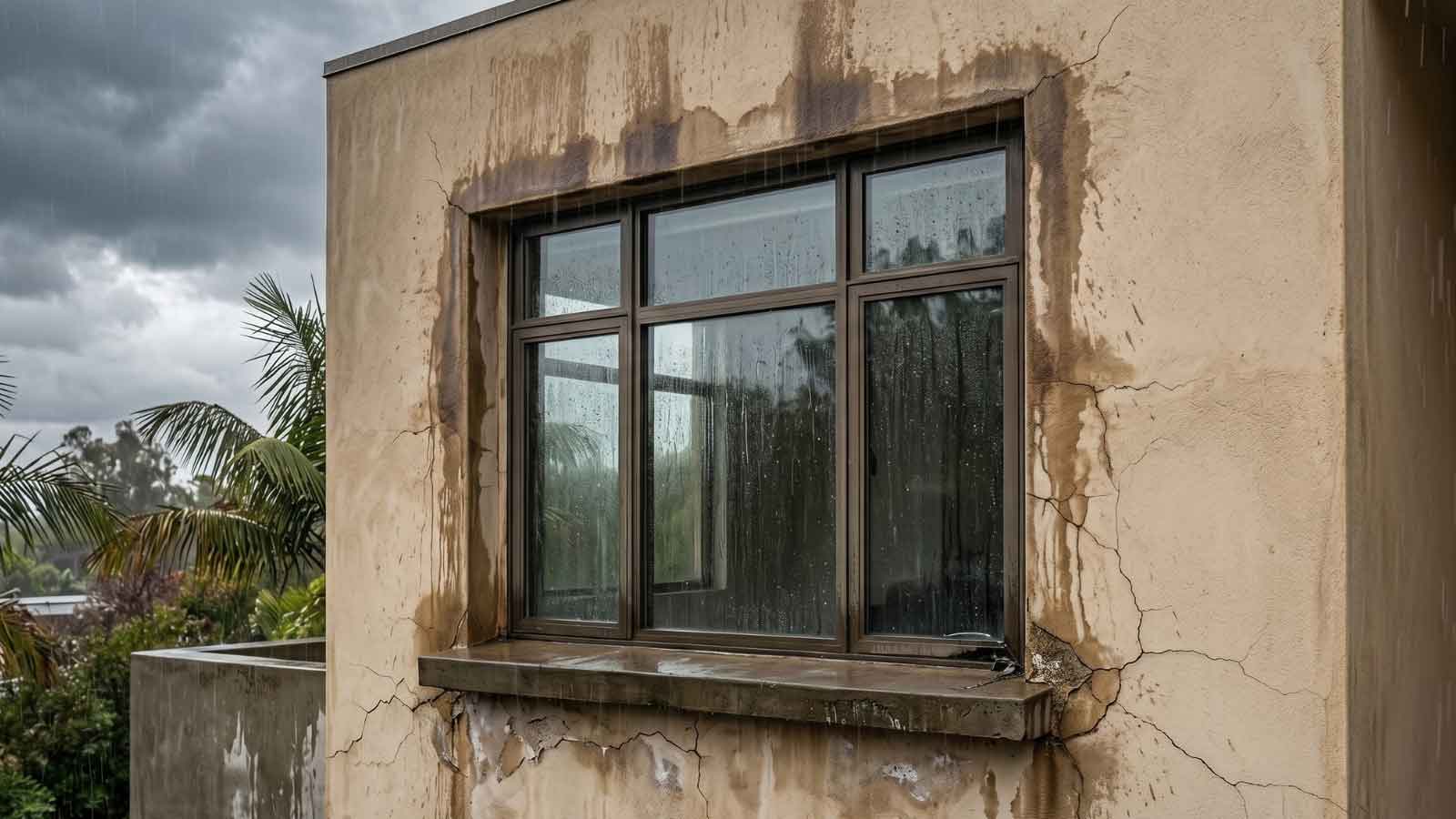

A water stain shows up near the corner of a window after a storm. The frame gets re-caulked, the wall dries out, and for a while, the problem seems solved. Then the next heavy rain hits, and the stain returns to the same spot or a few inches away.
That happens because water rarely enters where it becomes visible. In Los Angeles homes, moisture can travel behind stucco, flashing, roof transitions, and wall assemblies before it shows up inside. What appears to be a window issue may actually originate higher up the wall or at a nearby roof or balcony connection.
Stopping these leaks requires tracing the actual intrusion path, not just treating the surface symptoms. We use forensic inspection to locate the source of water entry, then match repairs to the specific failure point. So the fix addresses the cause, not just the stain.
Older stucco construction, aging sealants, and original window systems all contribute to the development of these wall and window leaks across Southern California properties.
A Leak Near the Window Is Not Always a Window Leak
Water that breaches the exterior of a building rarely surfaces where it entered. It follows framing, sheathing, and gravity until it meets a horizontal interruption, such as a window head, a door jamb, or a piece of trim. That is where the stain shows up.
Reading the stain helps narrow the possibilities before any testing begins:
- Staining at the head or upper jamb often points to a source above the window: a roof transition, a parapet, or a wall defect higher up
- Staining at the sill or lower jamb more often points to the opening itself: perimeter sealant, sill drainage, or weatherstripping
- Staining that spreads laterally or across an entire wall suggests the water is moving sideways inside the cavity before surfacing
Other clues tend to accompany hidden moisture: swollen trim, peeling paint, soft drywall, rust on fasteners, and a musty smell even when the surface feels dry. Once staining spreads into the wall cavity, the scope can expand toward wall leak repair rather than a window-only fix.
Is It Really Rain Intrusion? Other Moisture Sources to Rule Out
Before assuming a leak is rain coming through the envelope, a few other sources can produce similar staining patterns.
Condensation forms on the interior side of glass and frames during cool, humid mornings in coastal Los Angeles, especially with older aluminum frames that conduct cold to the interior surface. The water sits on the glass or runs down to the sill from inside.
Failed insulated glass units produce fogging between the panes and occasional moisture at the sealed edge, with no correlation to rain. HVAC issues such as a return air leak near an exterior wall, a poorly insulated duct, or unbalanced humidity can produce dry, dampened drywall near a window without any building-envelope failure. Plumbing in an adjacent wall is another candidate: a slow supply or drain leak above a window can mimic a roof or flashing problem, with the giveaway being that it shows up in dry weather too.
A useful rough test: track when the moisture appears. Only during or after rain points to intrusion. Cool mornings without rain point to condensation or HVAC. Wetness, regardless of weather, usually means plumbing.
Read More: Why Is Rain Leak Detection In Los Angeles So Important?
Where Water Actually Gets In Around Openings
When the source is rain intrusion at the opening itself, four building details account for most cases. Each fails in a different way and calls for a different repair.
Failed Sealant at the Perimeter
Caulking is the most visible part of the weather seal and the easiest to blame. Years of UV exposure cause sealants to crack, shrink, separate from the substrate, or lose adhesion to stucco and trim. A failed perimeter allows wind-driven rain to bypass the seal and enter the rough opening.
Sealant replacement works as a real fix when inspection confirms the seal is the actual failure point. Applied as a default solution without inspection, it tends to mask symptoms while the underlying issue continues to develop behind the assembly.
Flashing Problems
Flashing is the layered system that directs water away from the rough opening and out to the exterior face of the wall. Common failure patterns include missing pan flashing at the sill (which lets water enter the frame and soak the framing below), head flashing installed in the wrong overlap sequence (which channels water into the wall instead of away from it), and flashing punctured or cut back during stucco application or window replacement and never properly repaired.
Flashing failures are a common source of recurring leaks because surface-level repairs do not reach the defect. Diagnosing them accurately usually requires selective exploratory inspection or forensic testing.
Worn Weatherstripping and Misaligned Doors
Weatherstripping seals the gap between a moving sash or door panel and its frame. It compresses, hardens, and tears as it ages. Sliding patio doors are especially prone to alignment problems as tracks fill with grit and rollers wear, leaving the panel sitting against a partially compromised seal. During heavy rain, water that would normally drain to the outside of the track gets pushed past the seal and onto the floor.
Blocked Weep Holes and Drainage Paths
Many modern window systems are designed with internal drainage pathways that manage incidental water infiltration. On systems that use this design, weep holes at the bottom of the frame allow water to exit. When the weeps clog with paint, sealant, dirt, or insect debris, water backs up inside the frame.
Sliding door systems often use exterior drainage tracks that work the same way. A clogged track produces a leak that looks identical to a seal failure, which is why this category is often misdiagnosed.
Why Los Angeles Buildings Have Their Own Failure Patterns
A window installed in San Diego, Sacramento, and Phoenix will not age the same way as one in LA. Several local conditions shape how Los Angeles envelopes fail.
Older Stucco Construction
A large share of Los Angeles housing stock was built between the 50s and the 80s, often with single-layer stucco over felt paper and limited drainage detailing behind the finish. These assemblies predate many modern drainage-plane standards and detailing practices, so any breach tends to reach the framing quickly.
Hairline Cracks at Openings
Stucco moves. Hairline cracks routinely form at the upper corners of windows and doors where stress concentrates. During heavy rain, these cracks absorb water and channel it behind the finish until it reaches the rough opening from outside the visible frame.
A window can be intact yet show interior staining from nearby stucco intrusion. Our guide to stucco leak detection covers this pattern in more depth.
Flat Roofs and Hillside Drainage
- Low-slope roofs concentrate runoff at scuppers, drains, and parapet transitions. When those details fail, water spills onto the wall and runs down to the next horizontal interruption, often a second-story window or door head.
- Hillside lots add a lateral element. Soil saturation pushes water sideways into wall assemblies at unexpected points. A leak that appears to be a window issue on the downslope side of the house may actually be the wall acting as an unintended dam.
Wind-Driven Rain During Winter Storms
Southern California winter storms can push moisture horizontally against walls that are almost never exposed directly. Details that work fine during typical rainfall can fail during these events.
Aging Aluminum Sliders
Many 1960s and 1970s homes still have original aluminum sliding windows and doors. Seals are worn. Frames are thin. Drainage is limited. Even when the surrounding assembly is sound, the unit itself reaches the end of life.
Balcony Transitions and Retrofit Window Work
- Balcony and deck transitions. Water intrusion at balcony-to-wall joints can sometimes surface at interior door heads on lower floors.
- Retrofit window installations. Replacement window work over the last two decades has varied widely in quality, and retrofit units installed without proper flashing integration are a recurring source of intrusion in homes that were dry before the upgrade.
Multi-Story Travel Paths
Water entering at the roof or an upper floor in multi-story homes and condo buildings can travel several feet vertically before it surfaces. For HOAs and property managers, this matters as much for cost allocation as for repair, since the unit where the leak appears is often not the unit where the failure originates.
Homeowner Maintenance That Prevents Most Window and Door Leaks
A meaningful share of intrusion problems stems from deferred maintenance rather than construction defects. A short annual routine catches most of the early-stage issues:
- Clear weep holes at the bottom of window frames and sliding door tracks once a year. A toothpick or compressed air handles it.
- Inspect perimeter sealant at windows and doors each fall. Look for cracks, gaps, separation from the substrate, and chalky surface degradation.
- Sweep and rinse slider tracks monthly to keep the drainage path open and reduce wear on rollers.
- Walk the exterior after the first heavy rain of the season and note any stucco cracks at the upper corners of windows and doors, fresh stains on siding below openings, or runoff patterns that point toward window heads.
- Check parapet walls, scuppers, and roof drains before the rainy season starts.
These steps cost nothing and resolve a significant percentage of leaks before they ever reach an interior wall.
How a Forensic Inspection Finds the Source
Not every leak needs forensic testing. Simple cases like clogged weeps, worn weatherstripping, or visibly failed sealant can usually be diagnosed and corrected through maintenance. Forensic methods earn their place when leaks recur, the source is unclear, multiple potential entry points exist, or insurance and HOA documentation are involved.
A structured inspection can take a few hours and generally moves through three stages:
Visual Assessment
The visual survey starts outside. Sealant condition, visible flashing edges, stucco cracking, sill slope, head transitions, and adjacent roof or balcony features are documented through photos and notes. The output at this stage is a list of candidate failure points, not a diagnosis.
Moisture Mapping
Moisture mapping inside the wall comes next. Non-invasive moisture meters and thermal imaging identify wet zones behind the interior finish without opening drywall. A wet zone offset from the window points toward a wall or roof intrusion. A wet zone tight to the frame points toward the opening. A vertical band of moisture suggests an entry point higher up. Our overview of forensic leak detection covers the instruments and reading patterns in more depth.
Water Testing
ASTM E1105 water testing closes the loop. A controlled spray rack applies water at a known pressure to specific zones of the exterior in sequence: stucco field, head, jambs, sill, and adjacent transitions. Interior moisture readings during each test confirm or rule out that zone as the source. Exploratory openings or invasive inspection may be added when non-destructive methods cannot fully isolate the failure.
Repair Pathways: What Actually Gets Fixed
The right repair depends entirely on what the inspection found.
- Sealant-only repair applies when the perimeter seal is the actual failure and the assembly behind it is sound. Proper execution includes full removal of the old sealant, surface preparation, primer, if required by the manufacturer, and a sealant chosen for compatibility with stucco, frame material, and UV exposure.
- Localized flashing retrofit applies when flashing has failed at a specific zone, like the head or sill. The exterior finish is cut back at that location; the failed flashing is replaced with new flashing installed in the correct overlap sequence; the weather-resistive barrier (WRB) is tied back in; and the finish is restored.
- Layered drainage system repair is needed when the failure runs deeper than a single piece of flashing. If the WRB or the layered drainage system behind the stucco has gaps, the repair area expands. Stucco removal becomes necessary to access what is behind the finish and re-establish the water management layers.
- Full window or door replacement is the right answer when the frame is rotted, the unit is past its service life, or the rough opening has to be rebuilt for other reasons. New-construction-flange units typically require more exterior work. Retrofit units fit into the existing frame with less disruption, but only work when the existing assembly is sound.
Verification testing follows any significant repair. Repeating water spray testing on the corrected assembly confirms the source has been closed and provides documentation to support HOA review, contractor coordination, or an insurance claim.
Common Questions About Window and Door Leaks
How can I tell if water is coming through the window itself or through the wall?
Stain location helps, but does not confirm. Water entering through the wall above a window often surfaces at the head or upper jamb. Water entering at the opening tends to show at the sill or lower jamb. Moisture mapping and water testing produce a confirmed answer; visual inspection alone produces a working theory.
My window leaked again after I re-caulked it. What happened?
If the underlying flashing or drainage detail is compromised, new sealant may temporarily mask symptoms without resolving the moisture behind the assembly. The next storm tends to bring the leak back, sometimes in the same spot and sometimes a few inches over.
Could a stucco crack cause a leak that looks like a window leak?
Yes. Cracks near an opening absorb rainwater and channel it behind the finish until it reaches the rough opening from outside the frame. The window itself can be intact while the wall around it is the actual entry point.
My sliding door leaks only in heavy rain. What does that suggest?
Heavy-rain-only leaks often point to drainage rather than seal failure. When the exterior drainage track is partially blocked or the rollers have dropped the panel out of alignment, the system handles light rain fine, but overflows during intense storms.
How do I know if I actually need a forensic inspection?
A one-time stain from an obvious cause, like a clogged weep or aging caulk joint, usually does not. Recurring leaks, unclear sources, multi-unit buildings, hillside properties, visible water damage, and any situation involving an insurance claim or HOA dispute are where forensic methods tend to pay back the investment.
Let The Water Leak Experts Evaluate Your Property
Water stains around windows and doors rarely explain the full problem on their own. In many Los Angeles homes, the visible damage is only the point where moisture finally surfaced after traveling through the wall assembly.
Absolute Maintenance & Consulting investigates the actual source of intrusion through exterior envelope inspections and moisture mapping. Our team applies industry-standard diagnostic methods, including ASTM E1105 water testing and ASTM E2128 investigative protocols, under CSLB-licensed field supervision with IICRC-trained and MICRO-certified experience when required.
If a leak keeps returning, spreads during heavy rain, or still has no clear source after previous repairs, a diagnostic inspection can help narrow down exactly where the failure is happening and what scope of repair makes sense. Contact us today to schedule your inspection.
About the Author
 Cameron Figgins
Cameron Figgins is the founder of Absolute Maintenance & Consulting. With over 30 years of hands-on industry experience, he specializes in identifying complex water intrusion issues in Southern California homes and is dedicated to helping homeowners protect their property with the latest in detection technology.”