
Stucco Problems Unique to Los Angeles Construction
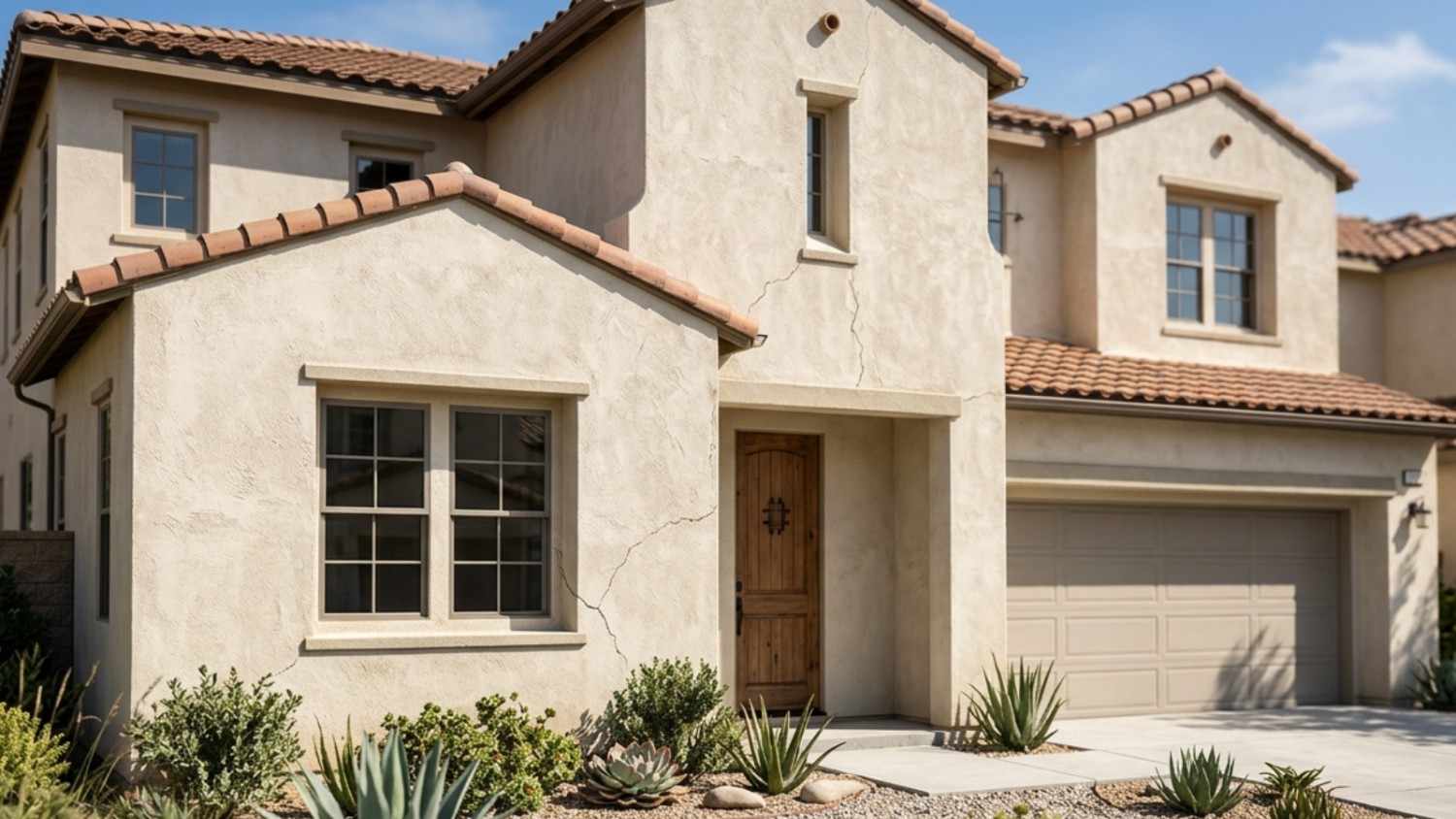

You spot a crack near a window. A faint stain starts to show through the paint after the first heavy rain. What looked fine yesterday now raises a simple question: Is this normal wear from LA weather, or the first sign of a deeper issue behind the surface?
Across Los Angeles County, stucco is the most common exterior finish on residential homes. When it’s properly designed and maintained, it performs well in this climate, but it also tends to develop recognizable patterns of wear shaped by Southern California’s heat cycles, soil movement, and construction practices. Understanding how those forces interact with the wall system helps make sense of what you’re seeing, from early warning signs to the conditions that typically call for a closer inspection.
What Drives Stucco Problems in Southern California
Three categories of pressure act on stucco walls in this region: weather cycling, ground movement, and construction detailing. Most local stucco issues stem from a combination of these factors, rather than a single cause acting alone.
Climate Cycling and UV Exposure
LA’s inland valleys and basins can swing by 30°F or more in a single day. Stucco is a rigid material that does not handle daily expansion and contraction gracefully, which produces hairline cracking along the weakest lines of a wall.
Ultraviolet radiation adds a second layer of stress. Acrylic and elastomeric finish coats lose flexibility over time under sustained UV exposure, and the surface coatings fade or thin. The wet season then concentrates rainfall into short, intense windows. Walls that baked dry for months meet driving rain at sharp angles, and any gap that opened during the dry season becomes a potential water entry point in stucco homes.
Read More: Why Sun-Exposed Coastal Buildings Need Exterior Stucco Waterproofing
Settlement, Soils, and Seismic Movement
LA homes sit on moving geology. Foundations settle on expansive clay soils that swell and shrink with moisture. Minor seismic events shift framing. Adjacent grading work and mature tree roots can lift slabs over time. Stucco, being rigid and tightly bonded to the wall assembly, often shows movement first as cracks at corners, openings, or material transitions.
Regional Construction and Detailing Patterns
Stucco performance also depends heavily on workmanship, and LA homes built between 1970 and 2000 carry the highest risk of water intrusion from construction-era defects. Installation patterns common to that period often included missing weep screeds, absent drainage planes, under-fastened lath, reverse laps in the weather barrier, and improper window flashing. These defects can remain invisible for years and surface only when the wall is under real environmental stress.
Read More: How Atmospheric Rivers Impact Stucco and Foundations in Southern California Homes
Stucco Systems Commonly Used in LA Homes
Not every stucco wall is built the same way. Four distinct systems most often appear on LA properties, each with its own failure profile.
Traditional Three-Coat (Hard-Coat) Stucco
Three-coat hard-coat stucco is the dominant exterior finish on LA residential homes. Spanish Colonial and Mediterranean Revival styles made it the authentic choice in older neighborhoods like Hancock Park, the Hollywood Hills, and Pasadena, and the post-World War II housing boom across the San Fernando Valley, San Gabriel Valley, and South Bay locked it in as the default on tract homes built between the 1940s and 1980s.
The system layers three cement-based coats (scratch, brown, finish) over metal lath. Durable and breathable but rigid, it cracks under the conditions covered above. Most failure patterns in this guide apply to hard-coat systems.
One-Coat Stucco on Commercial Buildings
One-coat stucco entered the LA market during the 1980s and 1990s, when multifamily and commercial construction surged, when speed and cost mattered more than resilience. The system applies a single layer of polymer-modified cement (3/8 to 1/2 inch thick) over foam insulation board and metal lath, and its lighter, faster installation made it common on garden apartments, retail strips, and mid-rise commercial buildings.
With only one cementitious layer, detailing at penetrations and transitions has to be precise. On properties where those details were rushed, one-coat assemblies tend to surface problems earlier than three-coat assemblies would.
EIFS (Exterior Insulation and Finish System)
EIFS shows up across LA on commercial buildings, mid-rise residential properties, and mixed-use developments built between the late 1980s and the mid-2000s. The surface looks like stucco, but the assembly is very different: rigid foam insulation board, a base coat with reinforcement mesh, and a synthetic finish on top.
Older barrier-style EIFS has a documented history of trapping water inside the wall, since there is no drainage path behind the foam. The risk amplifies during LA’s atmospheric river events. Newer drainage-style EIFS performs better but still depends on every seam, sealant, and transition holding, so it calls for the same inspection rigor as one-coat assemblies. How EIFS compares with lime and cement stucco is covered in Italian lime stucco vs EIFS vs cement stucco.
Venetian Plaster and Decorative Finishes
Venetian plaster shows up most often on LA’s luxury residential market: custom builds in Beverly Hills, Bel Air, the Hollywood Hills, Malibu, and Pacific Palisades, along with Mediterranean and Tuscan-style estates in foothill neighborhoods. The finish is striking but behaves very differently from cement-based stucco.
Lime-based Venetian plaster is more porous and depends on protective waxes for water resistance. On exterior walls, it needs more frequent upkeep and is more vulnerable to cracking and water entry once the wax has worn down. Coastal hillside properties take the worst of it, since UV exposure breaks down the wax faster than most owners expect.
If you are not sure which system is in your home, a quick inspection can identify it before any repair decision is made.
Read More: Why Do Stucco Sealants Keep Failing on Los Angeles Homes?
How Stucco Walls Handle Water (and Where They Fail)
Stucco itself is water-resistant rather than fully waterproof. The finish sheds most water on contact, but the wall system behind it does the real work of keeping water out of your home.
The Layered Wall Assembly
A properly built stucco wall layers the finish coat on top, lath underneath, a weather-resistive barrier (typically Grade D building paper or a modern house wrap) behind the lath, and structural sheathing and wood framing behind that. Water that gets through the finish is supposed to drain down the back of the assembly along the barrier and exit at the weep screed at the base of the wall.
The system works when every layer is intact, and every transition is detailed correctly. When any layer fails, water reaches the sheathing and framing, and that is where real damage starts.
Where Water Most Often Gets In
These are the most common entry points field inspectors encounter:
- Cracked surfaces near windows and doors (cracks 1/8 inch or wider)
- Failed sealants that have aged out of useful service
- Missing or poorly installed flashing at openings
- Absent kick-out flashing where rooflines meet walls
- Weep screeds blocked, painted over, or buried below grade (stucco should terminate at least 6 inches above ground level so the screed can drain)
- Cable, conduit, and vent penetrations sealed with caulk in place of proper flashing
Sealant and Coating Maintenance Lifecycle
Stucco finishes and the materials around them are not maintenance-free, and LA’s microclimates make a real difference in how long each material lasts.
Typical service intervals look like this:
- Caulks and sealants at windows, doors, and trim: 5 to 7 years
- Elastomeric coatings: 10 to 15 years when properly applied
- Homeowner visual walk-around: once a year, plus after major storms or seismic events
- Professional stucco leak detection assessment: every 3 to 5 years, or sooner if water signs appear
A home in Sherman Oaks or Pasadena takes more direct UV and bigger daily temperature swings than one in Santa Monica or Manhattan Beach, where the morning marine layer absorbs sunlight most days of the year. Expect the shorter end of each interval on south- and west-facing walls in inland and Valley neighborhoods, and the longer end on coastal or shaded elevations.
Reading the Warning Signs on Your Walls
Knowing how to respond to what you see on your walls depends on the pattern itself and the conditions that caused it. Most LA stucco issues fall into three groups, ordered by urgency.
Routine Wear (Monitor During Yearly Walk-Around)
These patterns are common across LA stucco and rarely structural on their own:
- Hairline cracks scattered across a wide wall field, often a response to daily thermal cycling on long elevations
- Shrinkage cracks on stucco less than two years old are a normal part of curing
- Small horizontal cracks at control joints are a sign that the joint is absorbing movement as designed
- Mild chalking or color fading on the west and south elevations is a sign of UV degradation of the top coat
These can be cleaned, sealed, and repainted as part of routine maintenance.
Watch and Reassess in 30 to 90 Days
These patterns are not alarming on their own but should be tracked, especially through LA’s wet season:
- A new crack with no clear cause yet
- Mild paint blistering on areas well above grade
- A single isolated stain after one rain event
- Light efflorescence in a small, localized spot
If any of these worsen between rain events or after a felt seismic event, escalate to a closer look.
Patterns That Call for an Inspection Now
These signs tend to combine LA-specific stressors (expansive clay soils, seismic activity, era-specific construction defects, or active water intrusion) and should be evaluated by a building envelope specialist:
- Diagonal cracks at the top corner of a window or door are a common settlement signal on LA’s clay soils
- Stair-step crack patterns that follow the line of the block or framing
- Cracks that widen over time or reopen after being sealed
- New cracks appearing after a felt seismic event, especially at openings or material transitions
- Brown or rust-colored staining around a crack or below a window
- Dark vertical streaks running below sills or roof edges are a sign of repeated water flow over a failing detail
- Bubbling or peeling paint on stucco
- Soft spots that yield under firm finger pressure (a saturated substrate)
- Expanding patches of efflorescence, the mineral signature of water moving through the wall
- Visible separation between stucco and adjacent trim, windows, or roof edges
- Interior staining, musty smells, or visible mold on a wall that backs an exterior stucco surface
Minor-looking exterior damage can mask saturated sheathing or framing inside the wall assembly, so the safe path for anything ambiguous is to have it inspected.
Why Stucco Repairs Need Diagnosis Before Patching
The most expensive mistake a property owner can make is to seal the symptom and walk away. A patch over a crack stops the visible damage for a season. If water enters elsewhere and travels along the wall to that crack, the patch traps water inside the assembly rather than keeping it out. The next round of damage tends to be larger and in a different location.
It is difficult to repair stucco correctly without first understanding where water is getting in, how it is moving through the wall, and what the assembly looks like behind the finish.
Tools That Help Locate the Cause
Building envelope inspections typically rely on a combination of:
- Thermal imaging: infrared cameras that reveal temperature differences caused by trapped moisture, even when water is not actively moving
- Moisture meters: handheld tools that confirm substrate moisture readings and quantify what the thermal image suggests
- ASTM E1105 water spray testing: a standardized pressure test that simulates wind-driven rain on windows and walls, helping isolate likely water intrusion points under controlled conditions
Results still need professional interpretation, since water often travels along framing for several feet before showing as interior damage. Our deeper look at thermal imaging for hidden leaks explains how this is used in practice.
What to Expect When You Schedule a Stucco Inspection
If the warning signs you have noticed match the patterns above, the next step is typically a professional inspection. Two practical questions usually come up first: what does it cost, and will homeowner insurance pay for any of it? A third consideration applies once the repair scope is set: do you need a permit? Here is what to plan for.
Will Homeowner Insurance Cover Stucco Damage?
Coverage depends on the cause of the damage, not the cost. Standard homeowner policies in California typically cover stucco damage caused by sudden events such as windstorms, hail, fire, or a tree falling on the wall. They typically do not cover gradual deterioration, deferred maintenance, or losses traced to construction defects.
This is why a documented inspection report matters. A report that identifies the cause, the affected materials, and the timeline of the damage gives your insurance adjuster something concrete to work with. If the damage traces to a construction defect, the same report supports a builder warranty claim or a California State License Board complaint instead.
For a fuller breakdown of how insurance applies to water damage claims in California, see our guide on water damage insurance claims.
Permit and Code Considerations in Los Angeles
Stucco work in Los Angeles may require a permit depending on the scope of repair. Cosmetic crack sealing usually does not. Removing and replacing larger sections may trigger a re-stucco review by the Los Angeles Department of Building and Safety. Commercial properties, HOAs, and multifamily buildings often face additional review steps.
Verify requirements with LADBS or a licensed contractor familiar with the current code before authorizing the work. Permitted repairs done right the first time cost less than redoing unpermitted work later.
Get a Proper Stucco Diagnosis Before Repair
If your walls are cracking, staining, bubbling, or showing soft spots, the next step is a building envelope inspection that targets the cause of the failure, not the symptom.
Absolute Maintenance & Consulting has over three decades of experience in LA water intrusion and envelope diagnostics. Our IICRC- and MICRO-certified team uses thermal imaging, moisture mapping, and ASTM E1105 water-spray testing to identify the source of stucco failure and document it for repair, insurance, or warranty purposes. Contact us to schedule an inspection and learn more about our stucco waterproofing in Los Angeles.
About the Author
 Cameron Figgins
Cameron Figgins is the founder of Absolute Maintenance & Consulting. With over 30 years of hands-on industry experience, he specializes in identifying complex water intrusion issues in Southern California homes and is dedicated to helping homeowners protect their property with the latest in detection technology.”