
What Is the Mold Remediation Process?
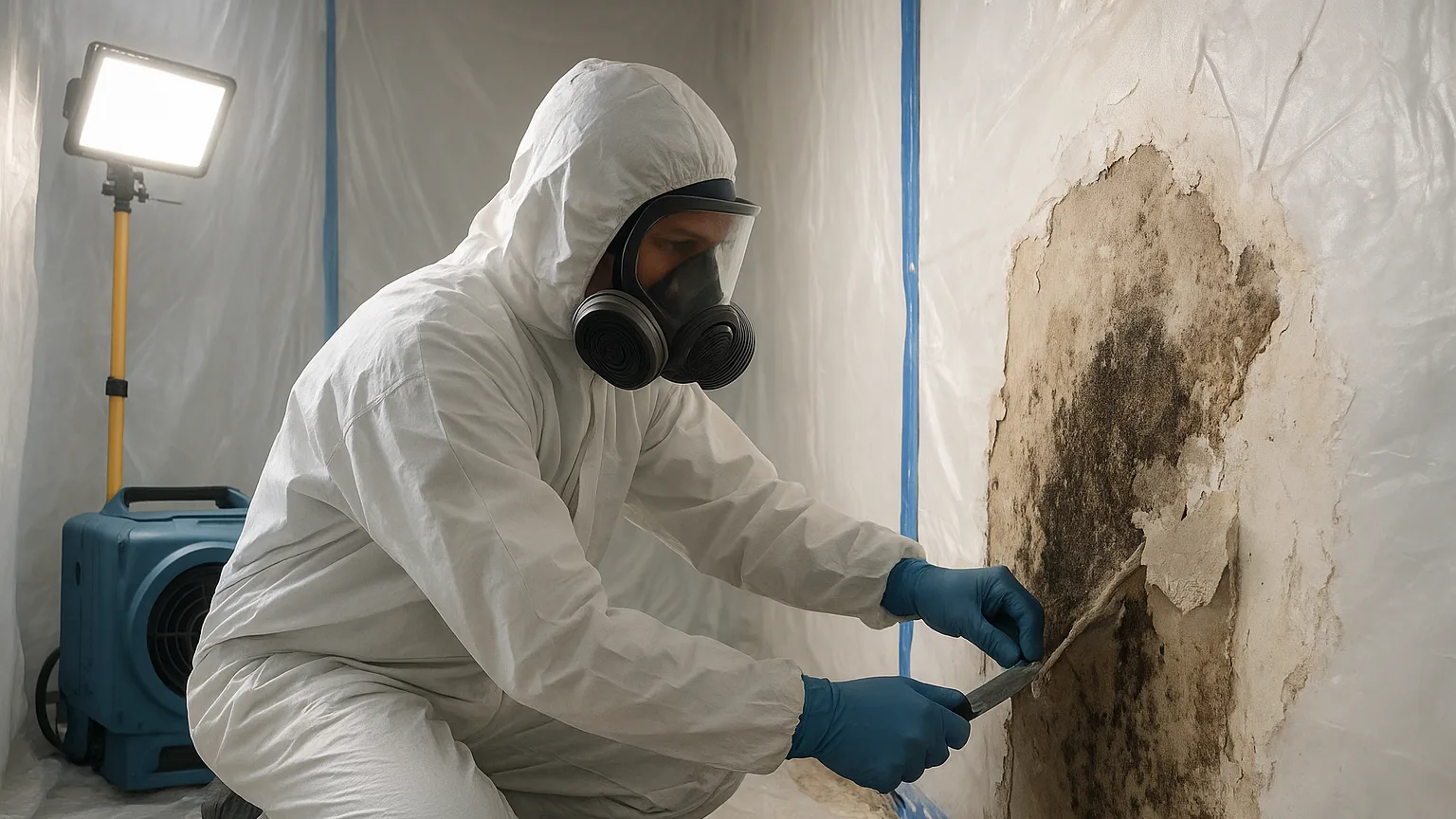

Mold remediation is a systematic, engineering-based protocol for identifying, containing, physically removing, and verifying the elimination of mold contamination in a building, beginning with moisture source control and ending with clearance testing that confirms safe spore levels have been restored.
Mold Remediation vs. Mold Removal: Why the Distinction Matters
The words “mold remediation” and “mold removal” are not interchangeable. Mold removal is only the physical act of wiping or scrubbing visible mold off a surface. Mold remediation is a complete engineering protocol governed by the IICRC S520 standard. It includes moisture source control, containment, HEPA filtration, physical removal, antimicrobial surface treatment, and clearance verification.
Using the wrong term has legal and insurance consequences. If an insurance adjuster sees “mold removal” on an invoice, they may deny the claim because it does not meet industry standards. In Los Angeles, property owners who hire a company for “removal” instead of “remediation” may face denied liability coverage if the mold returns or spreads.
The distinction affects cost and timeline. Mold removal is a quick, cheap surface fix that fails. Mold remediation is more involved, and it works because it addresses the root cause and confirms the space is safe afterward. For price ranges by project size, see mold remediation cost in Los Angeles.
We wrote an entire article on the difference between mold removal and remediation that you can read.
Step 1: Mold Inspection and Moisture Source Assessment
The mold remediation process always begins with a thorough mold inspection. I do a visual survey of every affected area, then use tools like infrared cameras to find hidden water behind walls, hygrometers to measure humidity, and moisture meters to check wood and drywall moisture content.
During the inspection, I document everything with photos, floor plans, and baseline readings of airborne mold spores. This documentation is necessary for insurance claims and for comparing against post-remediation clearance test results.
The primary goal of the inspection is to find the moisture intrusion source. Without identifying and stopping the water entry point, any remediation work is wasted. The mold will return.
Why Identifying the Water Source Comes Before Everything Else
In Southern California, common moisture intrusion scenarios include roof leaks from old Spanish tile, plumbing failures behind shower walls, and flood events from broken supply lines. The cause-and-effect chain is simple: water enters the building, relative humidity rises, dormant spores germinate, and colonization begins.
The EPA states that stopping the water source reduces the chance of mold regrowth by more than 90 percent. I have seen too many jobs where a homeowner paid to clean mold, but the leak was never fixed, and the mold returned within weeks.
Before remediation starts, verify the source is repaired. Use this checklist:
- Roof leak: confirm repaired by a licensed roofer and verified with a water test.
- Plumbing leak: confirm pipe replaced and pressure tested.
- Flood event: confirm standing water extracted and affected area dried within 48 hours.
Step 2: Containment, How Professionals Stop Mold from Spreading
A containment zone is a physically sealed work area built with double layers of 6-mil fire-retardant polyethylene sheeting. It is maintained under negative air pressure to prevent mold spores from migrating to clean areas of the building. Our guide to mold containment explains how this step protects the rest of the property.
Inside the containment zone, workers wear Cal/OSHA PPE requirements: N95 or higher respirators, goggles, gloves, and disposable coveralls. A decontamination station is set up near the exit so workers can clean off before leaving the zone.
After the zone is built, we monitor pressure differentials with a gauge to ensure negative pressure holds. We do visual checks daily to confirm no tears or gaps in the barrier.
When Is Full Containment Required? (The 100 Sq Ft Rule)
The EPA recommends full containment when the affected area is greater than 100 square feet, about the size of a 10×10 ft room. Full containment is also required for smaller areas if the space connects to the HVAC system or if high-risk occupants like children or elderly people are present.
To calculate the area, measure length times width of the affected wall or ceiling surface. Partial containment with a single layer of poly may be acceptable for small, isolated areas, but Los Angeles Housing Code enforcement officers often require full containment for any occupied rental unit.
Negative Air Pressure and 6-Mil Polyethylene Barriers
Negative air pressure is created by placing a HEPA air scrubber inside the containment zone. The scrubber pulls air out of the zone and exhausts it through a HEPA filter, lowering the pressure inside the zone. This makes air flow into the zone, not out, so airborne mold spores cannot escape.
I set up the containment zone with double layers of 6-mil fire-retardant polyethylene. We tape every seam with duct tape, seal doors and windows, and install a pressure gauge to maintain a negative pressure differential of at least 0.02 inches of water gauge, as specified by IICRC S520.
Step 3: HEPA Air Filtration and Airborne Spore Control
A HEPA air scrubber is a filtration device that captures 99.97 percent of particles 0.3 microns or larger, including mold spores. During the removal phase, these units run continuously.
I place one scrubber per 500 square feet of containment zone, positioned upwind of the source. The scrubbers must run for a minimum of 4 to 6 hours before and during the removal phase, or until airborne spore counts drop below 10 CFU per cubic meter.
For the rest of the building, I upgrade the HVAC filters to MERV 8 or higher and run portable HEPA units in occupied areas to capture any stray spores.
Step 4: Mold Removal and Surface Treatment
The removal phase has two parts: discarding porous materials and physically cleaning non-porous surfaces.
Porous building materials like drywall, insulation, ceiling tiles, and untreated wood must be cut out, double-bagged in 6-mil polyethylene, and discarded. Non-porous surfaces like metal, glass, and sealed concrete are scrubbed with a HEPA vacuum and then treated with an antimicrobial surface treatment.
The antimicrobial surface treatment is an EPA-registered chemical agent that kills residual fungal contamination. This is the correct treatment for salvageable surfaces, not bleach, which adds moisture and does not penetrate porous substrates.
Why Drywall and Porous Materials Cannot Be Saved
Mold hyphae, the thread-like structures that make up the colony, grow into the matrix of porous materials like drywall. You cannot scrub them out. The IICRC S520 standard states that drywall with visible mold growth beyond 10 square feet must be removed and discarded.
Leaving mold-infested drywall in place risks ongoing spore release and structural integrity concerns. The cost of removing and replacing the drywall is always lower than the cost of repeated remediation and potential health liability.
Proper Disposal: Double-Bagging in 6-Mil Polyethylene
Contaminated material must be removed without spilling spores into the building. The method is straightforward:
- Place each piece of cut drywall or insulation into a 6-mil polyethylene bag.
- Seal the interior bag with tape or a zip tie.
- Place the sealed interior bag into a second 6-mil exterior bag.
- Seal the exterior bag and label it “Mold Contaminated Material.”
- Transport the bags to a licensed hazardous waste hauler that complies with Los Angeles County Health Department requirements.
Why Bleach Does Not Work on Mold
Bleach is a myth in the mold industry. The EPA has found that bleach only kills surface spores on non-porous materials. On porous surfaces, the water in bleach soaks into the material, leaving the mold hyphae untouched and actually providing moisture for them to grow deeper.
Here is a comparison of bleach versus an approved antimicrobial treatment:
| Factor | Bleach | Antimicrobial Surface Treatment |
|---|---|---|
| Kills surface spores | Yes | Yes |
| Penetrates porous materials | No | Yes |
| Can cause spore re-sporulation | Yes (EPA finding) | No |
| Adds moisture to the material | Yes | No |
| Approved by IICRC S520 | No | Yes |
Step 5: Drying, Restoration, and Clearance Verification
After the mold is removed, the drying phase begins. I place commercial dehumidifiers and air movers throughout the area to pull moisture from the structure. I monitor moisture content with a meter until wood framing reads below 15 percent moisture.
Once the area is dry, restoration work begins: rebuilding walls, repainting, and reinstalling HVAC components. The last step is clearance verification. A qualified independent inspector conducts a post-remediation visual inspection and air sampling. The lab report must show airborne spore counts below 10 CFU per cubic meter before the containment zone can be removed and the space reoccupied. If you have been through a large water loss, do not skip this step. Only after you have clearance results in hand should you call your contractor for a follow-up or start rebuilding.
The 48-Hour Drying Window for Salvageable Materials
The EPA guidance is clear: moldy but salvageable items must be dried within 48 hours to prevent further growth. This includes hardwood floors, non-insulated metal framing, and certain furniture.
To dry a typical room, you need at least 1 CFM of airflow per square foot of floor area. For a 1,200-square-foot Los Angeles kitchen, this means setting up at least 1,200 CFM of air movers and a dehumidifier capable of extracting 70 to 100 pints of water per day.
If items exceed the 48-hour window, they must be discarded as porous materials. There is no saving them.
Mold Remediation Standards: IICRC S520, EPA Guidelines, and Cal/OSHA
The IICRC S520, 2024 edition, is the global benchmark for professional mold remediation. It details every step from moisture source assessment through clearance verification. Following it protects property owners from liability and insurance claim denials.
The EPA mold guidelines in “Mold Remediation in Schools and Commercial Buildings” are the primary reference for safe practices, especially for large commercial projects.
Cal/OSHA requires remediation workers to wear N95 or higher respirators, goggles, gloves, and disposable coveralls. A decontamination procedure must be followed before leaving the containment zone.
What Los Angeles Property Owners Must Know About Local Code Enforcement
The Los Angeles Housing Code addresses mold in sections such as 113.06 and 113.08. For rental properties, landlords must keep the premises free of conditions that cause mold growth. Failure to do so results in citations, “red tags” declaring the unit unsafe to occupy, and fines.
To stay compliant, property owners must keep documentation of the mold inspection report, the remediation contract, and the clearance test results. Scheduled follow-up inspections every 6 to 12 months can catch moisture problems early.
How Long Does the Mold Remediation Process Take?
A typical timeline for a 100-square-foot residential job is 3 to 7 days. Here is a realistic breakdown:
- Inspection and moisture assessment: 1 day
- Containment setup: 1 day
- HEPA air filtration: 2 to 4 days (runs continuously during removal)
- Physical removal of porous materials: 1 to 3 days
- Drying of remaining structure: 2 to 5 days
- Clearance verification: 1 day
Large commercial projects can take 2 to 3 weeks. Factors that accelerate the schedule include straightforward moisture sources, small affected areas, and quick sourcing of supplies. Weather in Southern California usually does not delay outdoor drying, but indoor drying can be slowed if the HVAC is compromised. Our commercial mold remediation page covers how we run those projects in occupied buildings.
When Do You Need a Professional Remediation Contractor in Los Angeles?
Call a certified contractor if any of these red flags apply:
- Affected area is larger than 100 square feet.
- HVAC system is contaminated with mold.
- Visible mold is on structural components like beams or subfloors.
- The occupant has a respiratory condition or weakened immune system.
California requires a C-61 contractor license for mold remediation, and EPA lead-safe certification is needed if lead paint is present. Hiring a professional ensures the documentation required by insurance policies and the Los Angeles Housing Code is produced.
Frequently Asked Questions
Can I clean mold myself with bleach?
No. Bleach does not kill mold on porous surfaces like drywall or wood. It adds moisture, which can worsen growth. The EPA and IICRC recommend physical removal and EPA-registered antimicrobial treatments instead of bleach.
How big does a mold problem have to be before I need a professional?
If the affected area is larger than 100 square feet, you need a professional. Smaller areas can often be handled by the owner with proper PPE, but any mold in the HVAC system requires a professional regardless of size.
Will my drywall need to be replaced during mold remediation?
Yes. Drywall is a porous building material. Once mold grows into it, it cannot be cleaned effectively. The IICRC S520 standard requires removal of any drywall with visible mold growth.
How long does the mold remediation process take?
For a typical 100-square-foot residential project, the process takes 3 to 7 days. Larger commercial projects can take 2 to 3 weeks.
What happens if mold is not remediated in a Los Angeles rental property?
The Los Angeles Housing Code allows for citations, “red tags” making the unit unsafe to occupy, and fines against the landlord. Tenants may also break their lease without penalty.
Does mold come back after remediation?
Mold will not return if the moisture intrusion source has been permanently resolved and the remediation followed IICRC S520 protocols with clearance verification. If the source is not fixed, mold will return regardless of how well the cleaning was done.
About the Author
 Cameron Figgins
Cameron Figgins is the founder of Absolute Maintenance & Consulting. With over 30 years of hands-on industry experience, he specializes in identifying complex water intrusion issues in Southern California homes and is dedicated to helping homeowners protect their property with the latest in detection technology.”